
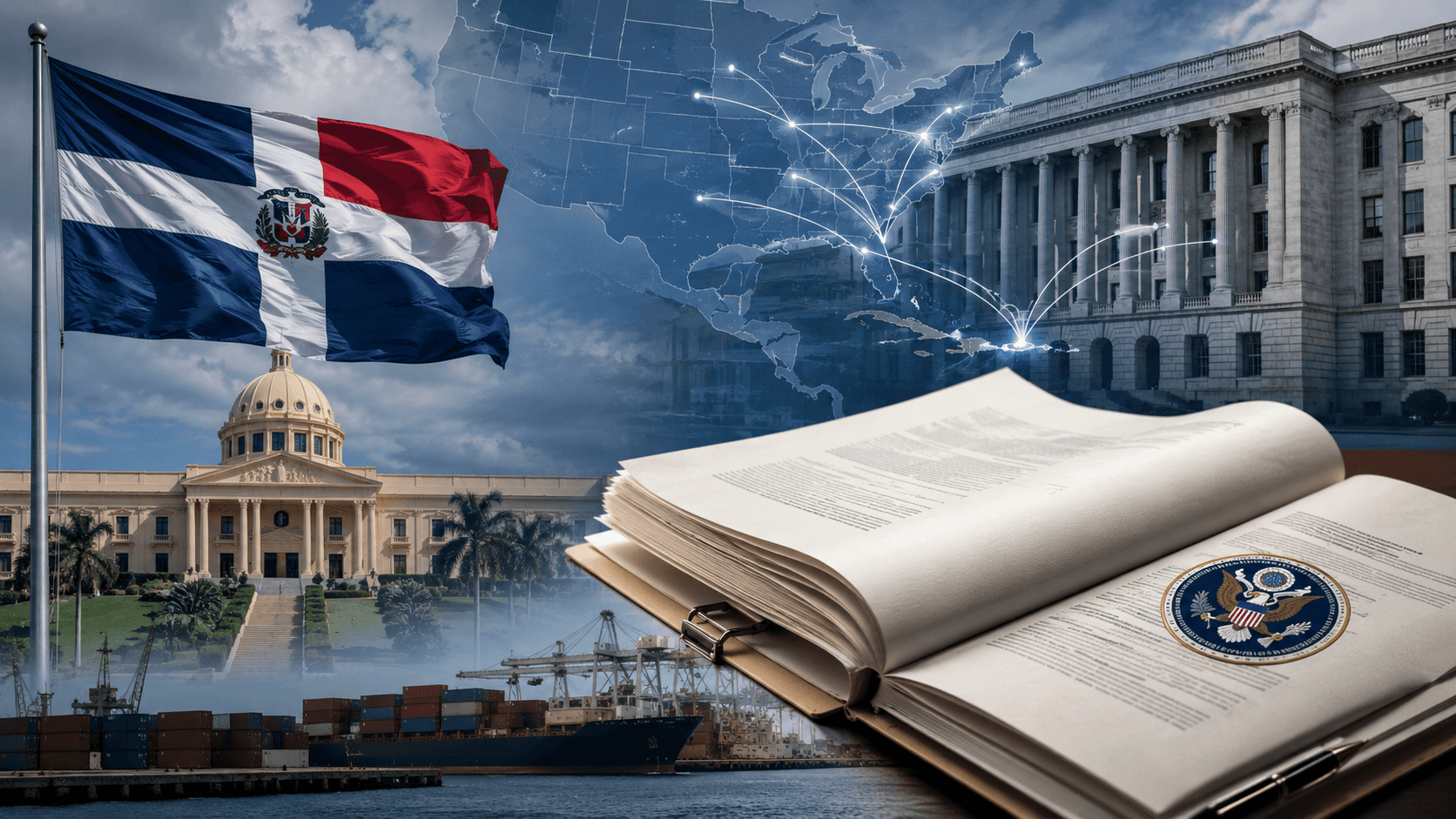

WASHINGTON, D.C. — The case file is anything but impressive.
It rests on the table looking like any other administrative document produced by the United States government. There are no photographs. No eye-catching graphics. No announcement of sanctions. The Dominican Republic is not even mentioned on its opening page.
Receive breaking news alerts
Immigration, New York, Dominican Republic and investigative news delivered directly to your phone and computer.

Free — unsubscribe anytime.
There is only an official heading, a date, and text written in the cold language of the federal bureaucracy.
Nothing suggests that these pages would ultimately lead to one of the most significant trade decisions adopted by Washington in recent years.
Months later, when the U.S. government announced new tariffs against sixty economies, the world learned the outcome.
Financial markets reacted.
Governments began calculating potential losses.
Businesses sought to measure the impact on their exports.
In the Dominican Republic, one unavoidable question emerged.
Why our country?
Most news reports attempted to answer that question by focusing on the end of the story.
Very few went back to the beginning.
That is precisely where this investigation starts.
Over the course of several weeks, El Faro Latino reviewed the official case file prepared by the Office of the United States Trade Representative (USTR), the notice published in the Federal Register, and the documents that shaped the administrative proceedings. Rather than examining them as separate records, they were read as a single story told by the documents themselves.
The result significantly changes the way this decision has been understood.
The record makes clear that the tariffs were not the product of an improvised reaction.
They were the culmination of a carefully structured administrative process supported by statutory authority, public consultations, technical analysis, and a methodology applied to sixty economies that together accounted for approximately 99.40 percent of U.S. imports.
That figure appears near the beginning of the report.
A casual reader could easily overlook it.
They should not.
It means the investigation was not directed at a small group of countries.
Nor was it limited to a particular region.
The USTR chose to examine virtually the entire universe of economies supplying goods to the world’s largest consumer market.
The Americas.
Europe.
Asia.
Africa.
Oceania.
Major industrial powers shared the same investigation with much smaller economies.
The Dominican Republic was one of them.
Up to that point, the case file still appears to be a highly technical document.
But only a few pages later comes the first major finding of this investigation.
For months, many assumed that the United States was investigating which countries were using forced labor.
The official record tells a different story.
And that difference changes the entire narrative.
The question posed by the USTR was not whether forced labor existed within a particular economy.
Instead, the agency sought to determine whether the economies under review had effective mechanisms in place to prevent goods produced with forced labor from entering their markets and continuing through international supply chains before ultimately reaching the United States.
The distinction may appear subtle.
It is not.
It is the legal foundation of the entire investigation.
In today’s global economy, very few products are manufactured entirely within a single country.
A mobile phone may contain minerals extracted on one continent, microprocessors manufactured on another, components assembled in a third country, and then be exported from an entirely different economy.
The same is true for clothing, medical equipment, household appliances, toys, and thousands of other products that cross international borders every day.
Each stage introduces new suppliers.
New companies.
New customs authorities.
New inspection systems.
And new risks.
For the USTR, the problem did not end where manufacturing began.
It extended throughout the entire supply chain.
That is why the opening pages of the report do not focus on individual countries.
Instead, they establish the framework by which every economy would be evaluated.
The investigation begins with a simple premise.
A law, by itself, does not guarantee results.
A country may explicitly prohibit forced labor.
It may incorporate that prohibition into its legal system.
It may establish criminal penalties.
It may create specialized enforcement agencies.
All of those measures may exist.
Yet they may still prove insufficient if the authorities responsible for enforcing them lack the practical tools needed to identify suspicious shipments, inspect them, detain them, and prevent them from continuing through international commerce.
That is precisely what the USTR sought to determine.
Not merely what the law said.
But what actually happened when a shipment arrived at a port.
Who had the authority to inspect it.
What procedures customs officials followed.
How the origin of imported goods was verified.
What happened when evidence of forced labor emerged.
And whether the entire system functioned effectively in practice.
As the review progresses, the administrative record reveals another characteristic that received little attention in media coverage.
This was not an investigation conducted solely by U.S. government officials.
The proceedings incorporated public comments, consultations with business organizations, labor groups, subject-matter experts, and other stakeholders involved in international trade.
Every submission became part of the administrative record.
Every comment had to be evaluated.
Every argument had the potential to influence the final determination.
That helps explain why several months passed between the opening of the investigation and the announcement of the tariffs.
This was not a decision that could be made in a matter of days.
The case first had to be built.
And building the case meant documenting every step of the process.
The record also reveals something else.
The USTR never presents this investigation as an isolated action.
Instead, it places the proceedings within a broader policy designed to strengthen oversight of international supply chains and prevent goods produced with forced labor from entering the U.S. market.
That context is essential.
It transforms the investigation.
It is no longer simply a case file intended to justify future tariffs.
It becomes an international assessment of the institutional capacity of sixty economies to address a problem that extends well beyond national borders.
It is at this point that the Dominican Republic begins to take on greater significance.
Not because the report singles it out immediately.
Quite the opposite.
For much of the investigation, the country remains one among the sixty economies under review.
Yet that apparent absence has a reason.
Before reaching individual conclusions, the USTR first had to establish the standards by which every participating economy would be evaluated.
As with any rigorous investigation, the methodology comes first.
Then comes the evidence.
Only afterward do the conclusions emerge.
Only then does the administrative record begin to answer the question that millions of Dominicans continue to ask:
Why did the Dominican Republic become part of a trade decision that altered the rules governing access to the world’s largest consumer market?

Comments (0)
Be the first to join the conversation.