
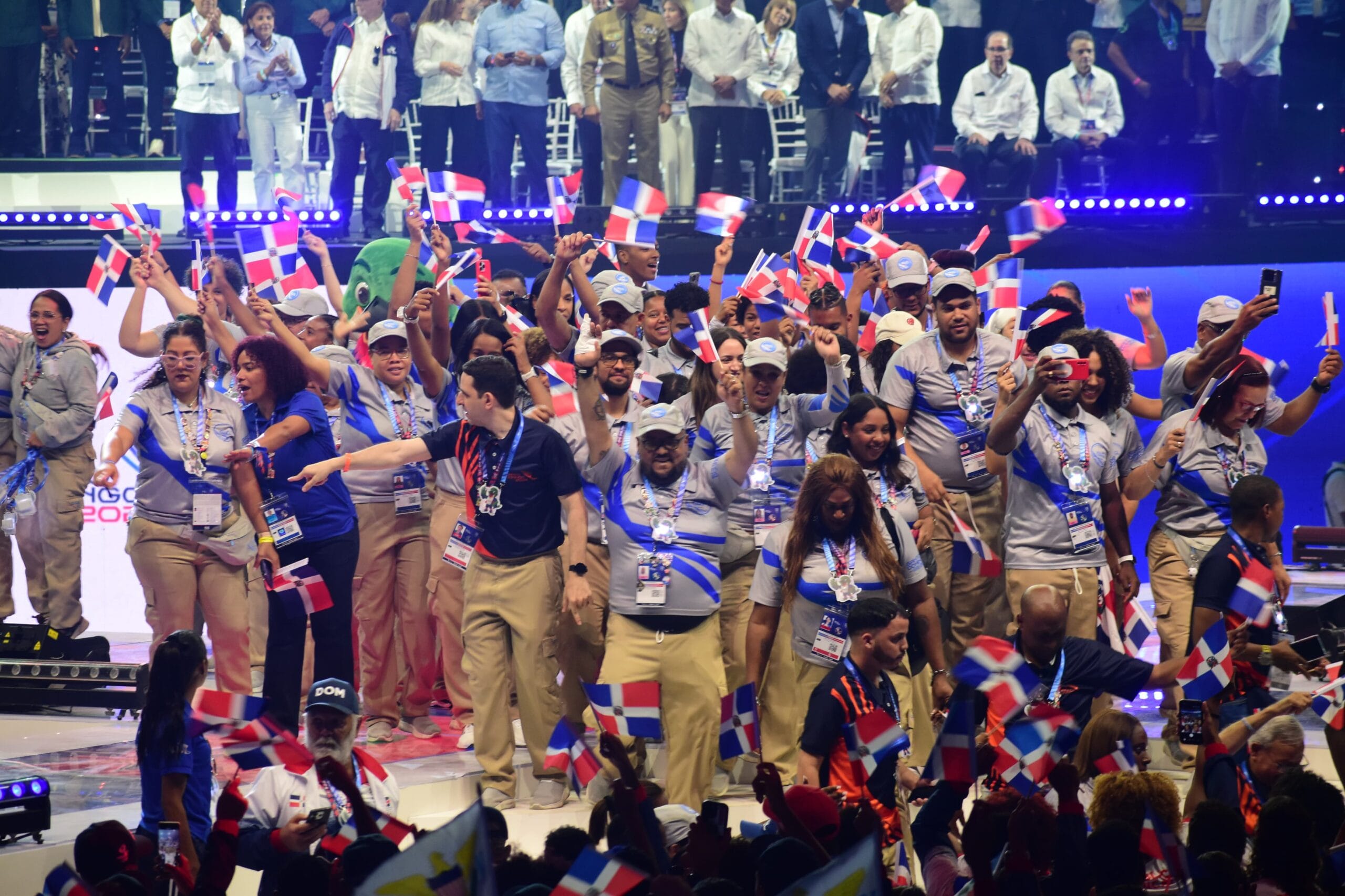

A group of 328 foreign volunteers joined the Santo Domingo 2026 effort, turning hospitality, service, and cultural diversity into a quiet competition of their own.
SANTO DOMINGO.— They arrived from Venezuela, Peru, Colombia, the United States, Haiti, and 28 other nations. They brought no competition uniforms, nor did they come chasing records. They arrived with credentials, work schedules, and a less visible mission: ensuring everything ran smoothly for those who had come to compete.
Receive breaking news alerts
Immigration, New York, Dominican Republic and investigative news delivered directly to your phone and computer.

Free — unsubscribe anytime.
These 328 foreign volunteers were part of the workforce behind the Santo Domingo 2026 Central American and Caribbean Games—an international presence revealing a rarely seen side of the region’s largest sporting event: behind every delegation, every venue, and every day of competition lay a network of people working to make the experience happen.
This data, recorded in a report presented to the Organizing Committee and updated as of August 5, 2026, takes on special significance when looking at where the volunteers came from. Venezuela contributed 55 volunteers; Peru, 39; Colombia, 35; the United States, 32; and Haiti, 28. Mexico added 25, while Cuba and Argentina contributed 20 each.
These are numbers. But they are also stories of mobility, connection, and service.
People who temporarily left their cities and routines to immerse themselves in a collective experience in the Dominican Republic. People who, instead of watching the Games from the stands, decided to be part of them from the inside.
The other delegation that arrived in Santo Domingo
At the Games, national delegations have a visible identity. Their uniforms, flags, and colors make them recognizable from a distance.
The foreign volunteer contingent works differently.
It does not compete as a delegation, yet it brings together a similar level of diversity. Its members come from countries with vastly different realities, speak with diverse accents, and bring experiences that converge at the sports venues, service centers, and operational hubs of the Games.
This is part of what makes Santo Domingo 2026 unique.
The city welcomed not only athletes, coaches, referees, officials, and journalists, but also individuals who chose to dedicate their time and skills to an event that belongs to the entire region.
As of August 5, 206 international volunteers had been accredited, while 130 had recorded verified participation in the attendance system.
However, the report offers a crucial clarification for interpreting this data: the available records represent a verified minimum rather than the full scope of participation. The system had logged activity at 43 of the 51 venues, and some shifts or activities had not yet been digitally entered.
Statistics, therefore, have their limits.
Human experience, however, does not.
The work that rarely makes it to TV
There is an aspect of major sporting events that seldom grabs the headlines.
It doesn’t appear when a medal is won. It receives no ovations. It has no awards ceremony.
It is the day-to-day work.
Guiding a visitor unfamiliar with the city. Helping a delegation locate a facility. Answering a question. Accompanying an athlete. Facilitating a process. Spotting a problem before it escalates into a major issue.
These actions may seem small in isolation. Together, they sustain a massive operation.
That is why volunteering cannot be viewed merely as an auxiliary force. In a Games that brings together thousands of people, it forms part of the human infrastructure that keeps the competition moving forward.
Santo Domingo 2026 featured a volunteer program with over 10,000 participants, distributed across various operational areas and trained to take on responsibilities within the organization. The 328 foreign athletes represent a fraction of that total group, yet they hold particular significance: they embody the international dimension of an experience that extends beyond the tracks, pools, gyms, and stadiums.

Comments (0)
Be the first to join the conversation.