
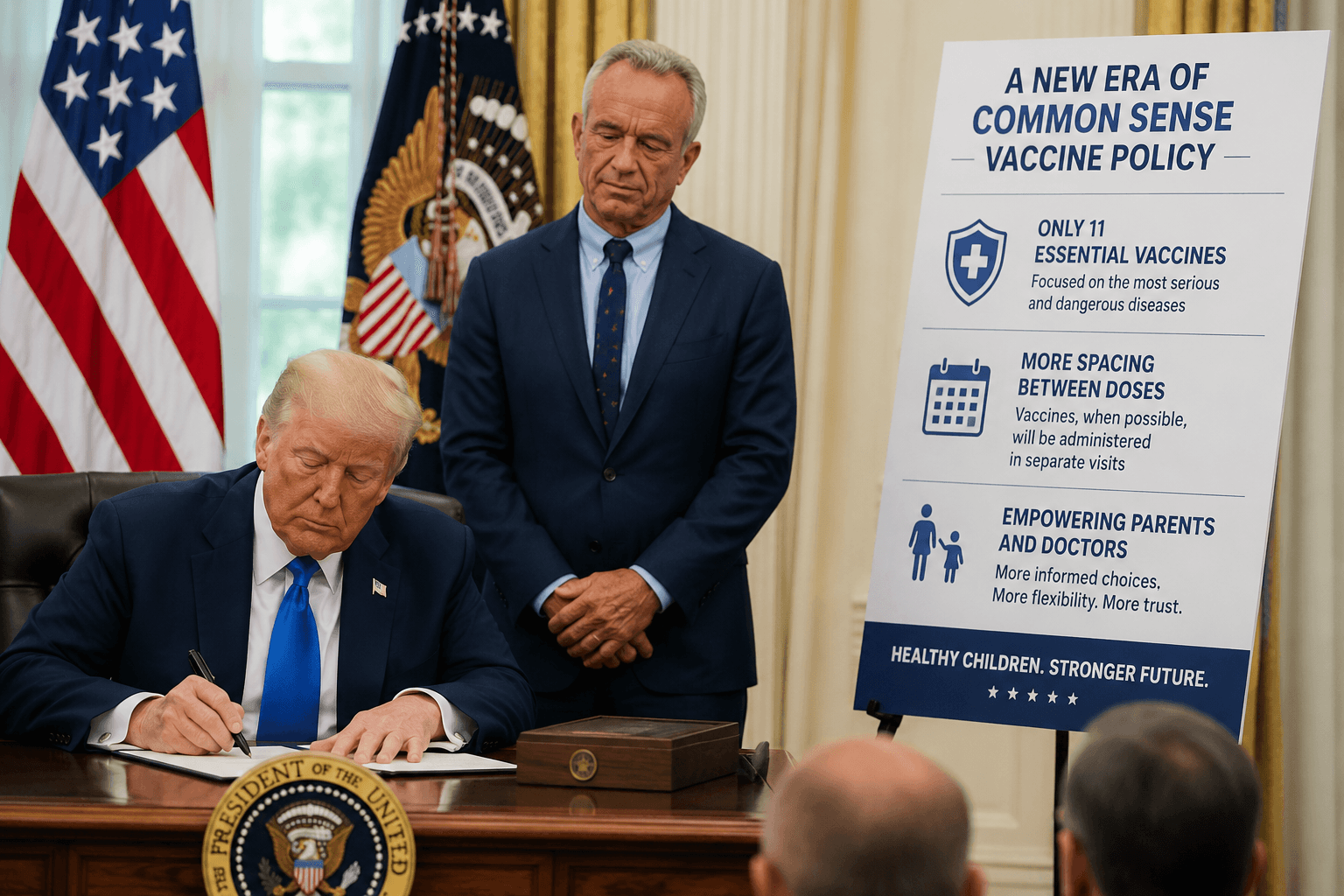

WASHINGTON – President Donald Trump signed an executive order Monday directing a major overhaul of U.S. childhood vaccination policy, an initiative backed by Health and Human Services Secretary Robert F. Kennedy Jr. that seeks to reduce the federal schedule to 11 vaccines considered essential and promote greater spacing between doses administered to children.
The order also proposes separating the combined measles, mumps and rubella vaccine, known as MMR, so that the three immunizations can be administered individually, an option that is not currently available in the United States.
Receive breaking news alerts
Immigration, New York, Dominican Republic and investigative news delivered directly to your phone and computer.

Free — unsubscribe anytime.
During an event at the White House, Trump presented the measure as part of an effort to give parents greater decision-making authority and review federal childhood vaccination policies.
“Effective immediately, my administration recognizes gold-standard recommendations for only 11 core childhood vaccines against the most serious and dangerous diseases,” Trump said during the ceremony.
The president also expressed his desire to have the MMR vaccine divided into individual immunizations.
The decision represents one of the most significant changes advanced so far by the Trump administration in the area of children’s health and consolidates several proposals promoted by Kennedy since taking over the Department of Health and Human Services.
The new policy follows a government-ordered review comparing the U.S. vaccination schedule with those used in other developed countries. The administration maintains that the United States recommends a greater number of childhood immunizations than many comparable nations and that there is room to provide parents and physicians with greater flexibility.
The government had previously identified 11 diseases as part of a core vaccination schedule: measles, mumps, rubella, polio, pertussis, tetanus, diphtheria, Haemophilus influenzae type B, pneumococcal disease, human papillomavirus and chickenpox.
The order signed Monday goes further by recommending that, when possible, childhood vaccines be administered during separate visits and directing the Department of Health and Human Services to develop a plan that would make measles, mumps and rubella vaccines available separately.
There are currently no individually licensed and available vaccines in the United States for each of those three components, meaning that implementing that portion of the policy would require additional changes.
The order also directs the Department of Health and Human Services to strengthen vaccine research and reaffirms the administration’s approach of giving parents and physicians a greater role in immunization decisions.
Another component of the measure could generate a legal battle with the states.
The administration directed the Department of Justice to examine and, when deemed appropriate, challenge state vaccination laws that the federal government believes may conflict with parental rights, religious freedoms, certain medical exemptions and other constitutional protections.
Vaccination requirements for school enrollment have traditionally been established primarily by the states, meaning this aspect of the order could lead to new litigation over the limits of federal authority.
The administration said, however, that access to vaccines will continue through the Vaccines for Children program, which provides immunizations to children whose families might otherwise have difficulty paying for them.
Kennedy said federal authorities are also developing new research related to the causes and biology of autism.
During the announcement, Trump again raised questions about a possible relationship between vaccines and the increase in autism diagnoses.
Those remarks prompted an immediate response from medical experts and organizations because numerous studies conducted over several decades have found no scientific evidence demonstrating that vaccines cause autism.
The American Academy of Pediatrics rejected the changes announced by the administration, arguing that no new scientific evidence has emerged to justify altering childhood vaccination recommendations in this manner.
Its president, Dr. Andrew Racine, warned that the announcement could create uncertainty and confusion among families.
Other specialists said separating vaccines across multiple medical appointments could lead to delays in immunization and leave some children unprotected against preventable diseases for longer periods.
Pharmaceutical company Merck, which manufactures the MMR vaccine, also maintained that there is no published scientific evidence demonstrating a benefit from dividing the combined immunization into three separate vaccines. The company warned that increasing the number of injections and medical visits could result in delays or missed doses.
Opposition to the order also came from within Republican ranks.
Sen. Bill Cassidy of Louisiana, a physician and chairman of the Senate Health Committee, publicly rejected the decision and maintained that vaccines are safe and do not cause autism.
The debate follows months of changes and controversies surrounding federal immunization policy under Kennedy’s leadership.
In early 2026, the Department of Health and Human Services had already reduced universal recommendations in the childhood vaccination schedule, but some of those changes were later halted by a federal court ruling. The new executive order reaffirms the administration’s intention to continue that transformation while litigation proceeds.
Monday’s announcement therefore opens a new chapter in the national debate over vaccines.
For the Trump administration, the initiative is intended to give families greater freedom of choice, reconsider the number and frequency of immunizations and bring the U.S. system more closely in line with practices used in other developed countries.
For major medical organizations and infectious disease specialists, however, reducing or delaying certain vaccinations could increase the risk that children remain vulnerable to diseases that have been controlled for decades through immunization programs.
The practical implementation of the order will now depend on actions taken by the Department of Health and Human Services, the CDC and other federal agencies, as well as any legal disputes that may arise over state vaccination requirements.

Comments (0)
Be the first to join the conversation.