
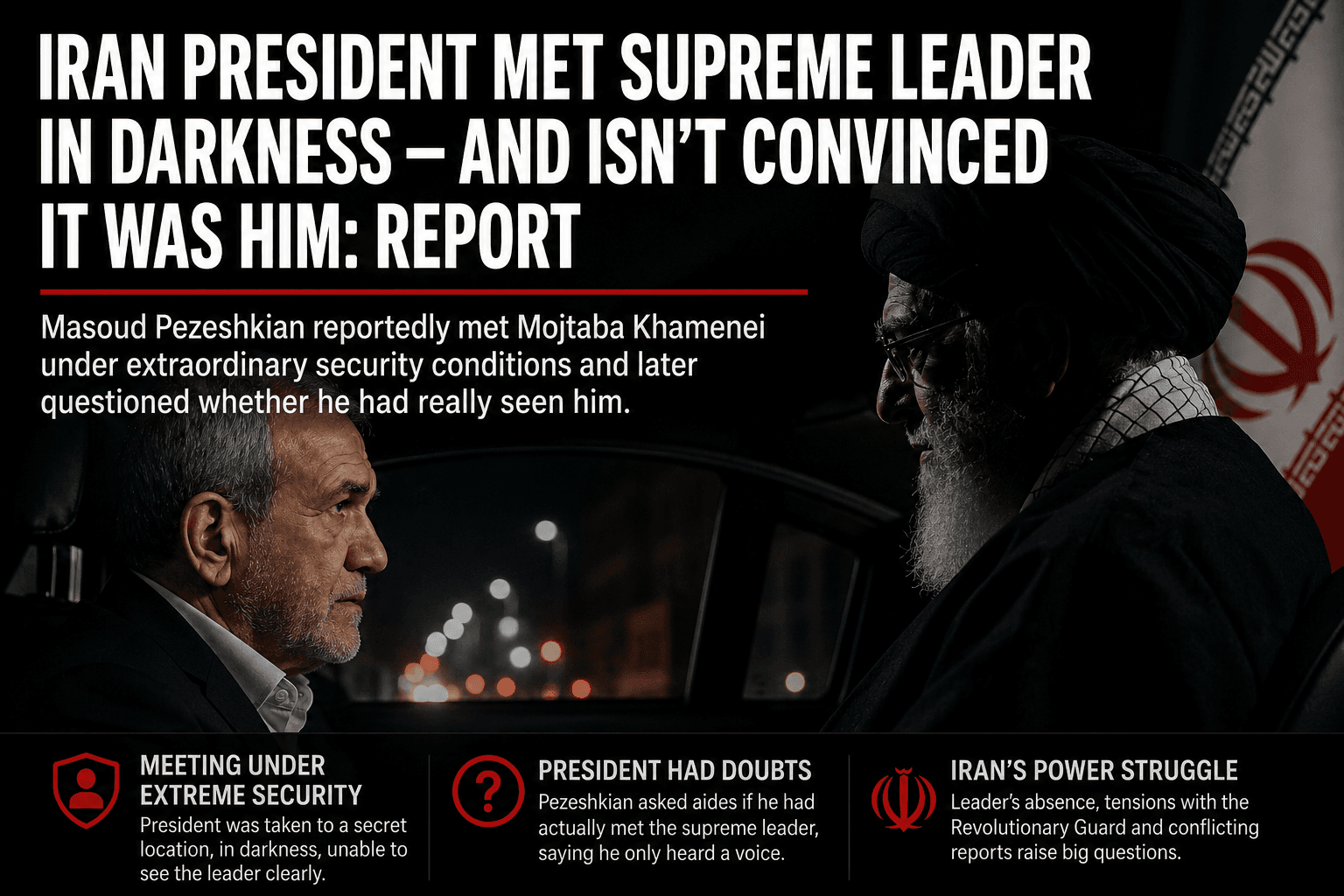
TEHRAN.— The prolonged isolation of Iran’s new supreme leader, Mojtaba Khamenei, has opened an extraordinary chapter within the Islamic Republic’s power structure. A journalistic investigation claims that even President Masoud Pezeshkian could not determine with certainty whether the man with whom he held a secret meeting was actually the country’s highest authority.
The account, initially reported by Iran International and later picked up by the New York Post and other international media outlets, describes a meeting conducted under security conditions considered unusual even by the standards of the Iranian regime. Pezeshkian was reportedly taken to a secret location in Tehran and separated from his usual security detail before being escorted to a vehicle with darkened windows.
Receive breaking news alerts
Immigration, New York, Dominican Republic and investigative news delivered directly to your phone and computer.

Free — unsubscribe anytime.
Inside the vehicle, according to sources cited by Iran International, there was virtually no light. The president was reportedly told that the man sitting next to him was Mojtaba Khamenei, but the conditions prevented him from clearly seeing his face. He was also reportedly unable to shake his hand.
The meeting allegedly lasted only a few minutes. According to those sources, Pezeshkian emerged with enough uncertainty that he later asked people around him whether he had actually been in the presence of the supreme leader. During the conversation, he reportedly heard primarily a voice in the darkness, without being able to visually verify the identity of the person speaking to him.
The account has not been independently verified, and Iranian authorities have not publicly confirmed that the meeting took place under those conditions. That distinction is important because a considerable portion of reporting about internal power struggles within the Iranian regime comes from anonymous sources and media outlets critical of the government in Tehran.
What has been confirmed is that Pezeshkian has been in contact with the new supreme leader. Iranian state media recently reported a meeting between the two in late July, information subsequently reported by Reuters. According to the official account, the meeting addressed military and economic matters, including foreign currency management, energy and international economic relations.
The controversy has taken on greater significance because of Mojtaba Khamenei’s near-total disappearance from public view since succeeding his father, Ali Khamenei, who was killed during U.S. and Israeli attacks against Iran that began on February 28.
Mojtaba was also reportedly seriously wounded during those attacks. Since then, his absence from public events has fueled speculation about his physical condition and about who is actually exercising power inside Iran.
The new supreme leader was also not visibly present at his father’s funeral, held months later. Images from the ceremony showed other members of the Khamenei family and prominent political and religious leaders, but did not provide a verifiable appearance by Mojtaba. His absence turned the funeral into another source of questions surrounding his condition.
For months, communications attributed to the Iranian leader have been delivered primarily through written statements. The absence of recent photographs, public speeches and independently verifiable appearances has been particularly striking in a political system where the supreme leader stands at the center of religious, military and strategic authority.
The pressure generated by these doubts appears to have prompted Iranian authorities to respond. Qasem Qoraishi, a senior official in the Basij organization, announced that images would be released showing Khamenei among citizens and meeting with commanders of the Armed Forces. So far, however, the images that have emerged have not completely resolved questions about when they were recorded.
The episode also comes amid signs of tension between Pezeshkian and the Islamic Revolutionary Guard Corps. Iran International has published reports in recent months suggesting that the president believes military sectors have significantly reduced his government’s decision-making authority.
The same outlet reported that Pezeshkian had submitted a resignation letter alleging that the Revolutionary Guard had assumed fundamental functions of the state. Officials linked to the government later denied that the president had resigned, and Pezeshkian continued carrying out his duties.
Beyond those conflicting accounts, recent developments point to a clear strengthening of figures emerging from the military and security establishment. Mojtaba Khamenei has placed hard-line officials in strategic positions, while Ahmad Vahidi heads the Revolutionary Guard and veterans of the security apparatus have gained greater influence over national decision-making.
That process has placed the true distribution of power in Tehran under increasing scrutiny. Pezeshkian, considered comparatively more pragmatic and more receptive to international dialogue, formally remains at the head of the government, while hard-line sectors control much of the country’s military and security structure.
The question surrounding Mojtaba Khamenei, therefore, is no longer limited to his health.
His prolonged absence from public view, the extraordinary security measures apparently surrounding his contacts, conflicting accounts of his meetings with the president and the simultaneous strengthening of the Revolutionary Guard have raised a much larger question about Iran’s future: Who is actually making the decisions in the Islamic Republic?
The answer remains hidden behind one of the most secretive circles of power in the world.

Comments (0)
Be the first to join the conversation.