
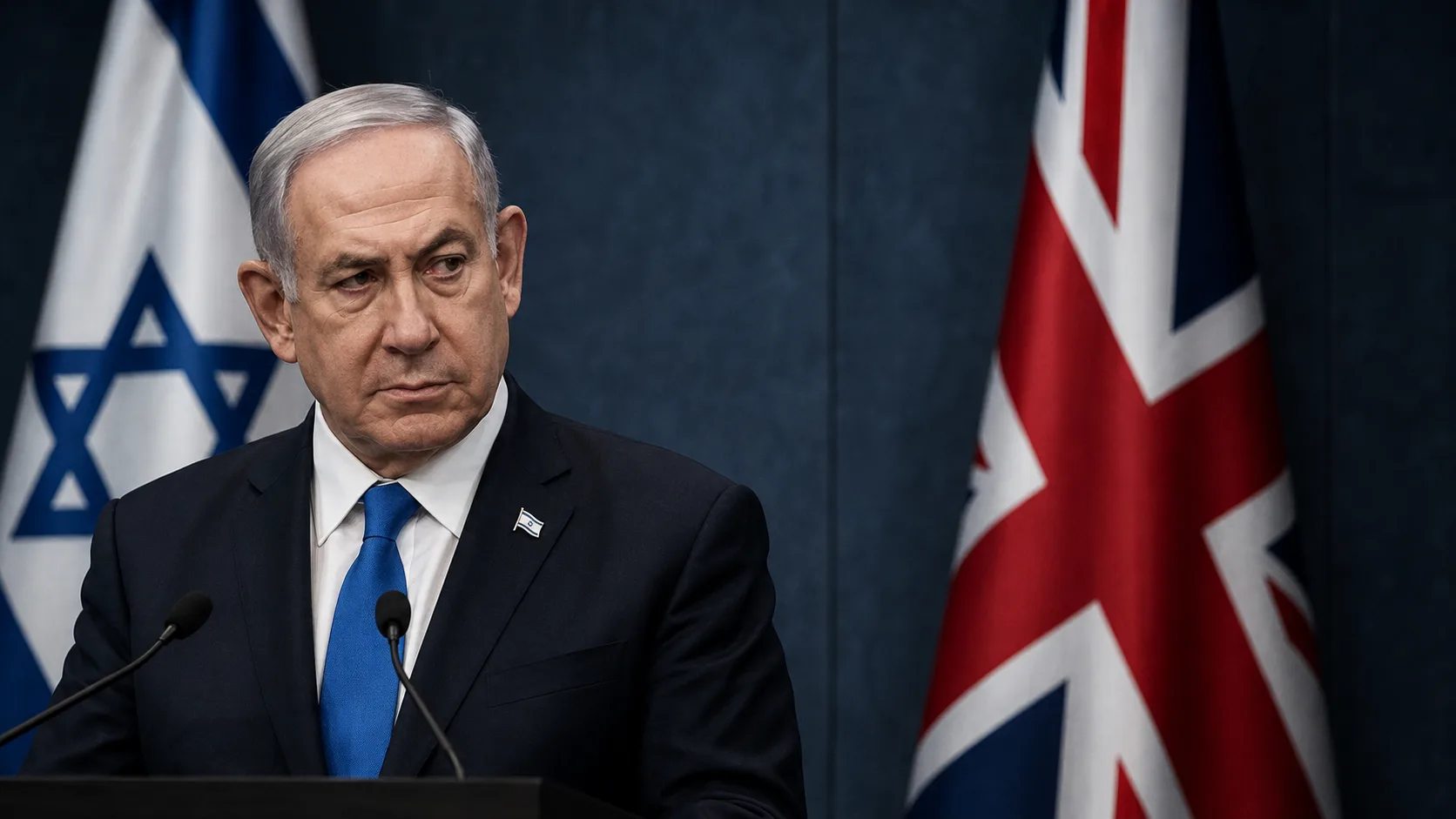

LONDON.— Benjamin Netanyahu turned his attention toward one of Israel’s traditional allies and used a podcast interview to describe the United Kingdom as “the Islamic Republic of Britain,” a remark that immediately widened an already visible diplomatic divide.
The Israeli prime minister went even further. During the interview for Israel’s Army Radio, he repeated the claim that Britain could become “the first Islamic republic to get a nuclear weapon,” language associated with a far-right narrative that portrays the country’s relatively small Muslim population as a threat to its national identity.
Receive breaking news alerts
Immigration, New York, Dominican Republic and investigative news delivered directly to your phone and computer.

Free — unsubscribe anytime.
The remark emerged while Netanyahu was recalling the favorable coverage Israel received more than half a century ago from journalist Randolph Churchill, the son of former British prime minister Winston Churchill.
“Go find that in today’s Britain, in what is called the Islamic Republic of Britain,” Netanyahu said.
The interviewer did not challenge the description directly. Instead, he asked whether Netanyahu was unfairly singling out the United Kingdom when similar political changes could be seen elsewhere in Europe.
Netanyahu did not retreat.
“Yes, but you know someone said the first Islamic republic with nuclear weapons will be the Islamic Republic of Britain,” he replied.
The statement overlooked an obvious historical fact. Pakistan, whose official name is the Islamic Republic of Pakistan, has possessed nuclear weapons since the 1990s. But the significance of Netanyahu’s words extended beyond their factual contradiction. They were aimed at a country whose relationship with Israel has become increasingly strained in recent months.
That tension intensified after Andy Burnham entered No. 10 and signaled a change in Britain’s approach to the war in Gaza. Shortly before becoming prime minister, Burnham apologized for Labour’s initial response to Israel’s military campaign, acknowledging that the party “didn’t get it right” and promising that his government would “do better.”
By July, Burnham had hardened that position. He said Britain would increase pressure on the Israeli government, considering additional sanctions against individuals and entities, along with a possible ban on trade involving goods produced in illegal settlements.
Netanyahu’s language was not entirely new in international conservative politics. During the 2024 presidential campaign in the United States, JD Vance, now vice president, made a similar remark when he suggested that Britain could become the first “truly Islamist country” to possess a nuclear weapon.
London Mayor Sadiq Khan has also repeatedly found himself at the center of attacks from right-wing political figures abroad. Those attacks, including comments by Donald Trump, have often relied on false or racialized claims tied to Khan’s Muslim faith and Britain’s immigration debate.
Inside the United Kingdom, Muslim leaders have warned that the consequences of such rhetoric are no longer confined to political speeches or social media. They say hate crimes targeting their communities have reached alarming levels as far-right movements grow stronger and anti-immigrant parties gain support.
The criticism of Netanyahu also came from within Israel.
Avi Dabush, a candidate for the Knesset with the opposition Democrats party, accused the prime minister of ridiculing an important ally at a moment when Israel is confronting unprecedented international isolation.
“That’s what happens when there’s a horrific diplomatic failure, and an inability to rally countries in the world in favour of our interests,” Dabush wrote on social media.
Netanyahu leads what has been described as the most far-right government in Israel’s history. Under his leadership, relations with several longstanding allies have deteriorated while his government has drawn closer to international far-right figures, including some accused of having histories of antisemitism.
The British government responded without ambiguity.
“These comments are completely unacceptable, and we have raised them with the Israeli government,” the Foreign, Commonwealth and Development Office said.
The Israeli Prime Minister’s Office did not respond to questions about whether Netanyahu’s statement represented the official position of his government. The silence left the remark standing on its own, deepening the impression of a relationship no longer defined by automatic cooperation, but by growing distrust between two countries that once spoke to each other as dependable allies.

Comments (0)
Be the first to join the conversation.