
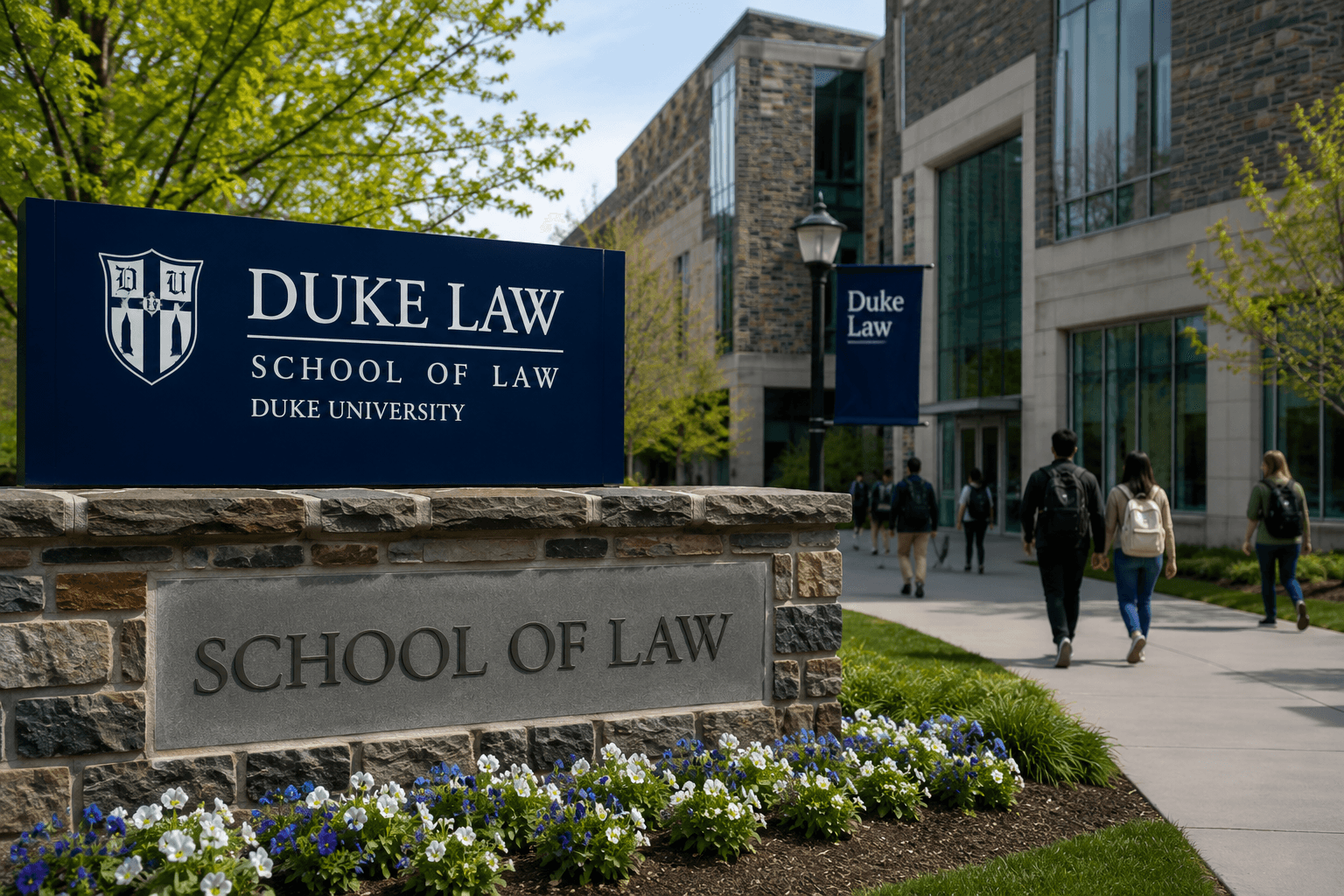

DURHAM, North Carolina.— Duke University School of Law is facing accusations from the U.S. Department of Justice that it continued giving admissions advantages to Black and Hispanic applicants over similarly qualified White and Asian candidates after the Supreme Court restricted the use of race in college admissions.
The Justice Department’s Civil Rights Division alleges that Duke Law used applicants’ racial backgrounds as a factor in admissions decisions while pursuing its diversity objectives, despite the Supreme Court’s landmark 2023 decision in Students for Fair Admissions v. Harvard.
Receive breaking news alerts
Immigration, New York, Dominican Republic and investigative news delivered directly to your phone and computer.

Free — unsubscribe anytime.
Assistant Attorney General Harmeet Dhillon, who leads the Civil Rights Division, said universities cannot justify racial discrimination by arguing that their intentions are aimed at creating a more diverse student body.
“Duke Law School doesn’t get a free pass to discriminate against white and Asian students simply because it thinks it has good intentions,” Dhillon said.
The Supreme Court’s 2023 ruling fundamentally changed the legal landscape for university admissions. In cases involving Harvard University and the University of North Carolina, the court held that the race-conscious admissions systems at issue violated constitutional or federal civil rights protections.
The decision did not prevent universities from considering how an applicant’s personal experiences, including experiences involving race, may have shaped that individual’s character or accomplishments. But the court made clear that institutions could not simply recreate race-based admissions preferences through essays or other indirect methods.
That distinction is now at the center of the federal government’s case against Duke.
The Civil Rights Division began investigating Duke Law in April 2025. According to a Justice Department letter outlining its findings, federal investigators concluded that significant racial disparities remained in the law school’s admissions process after the Supreme Court ruling.
The department alleges that among applicants seeking admission in 2025, Black candidates had approximately 3.5 times the likelihood of admission as Asian candidates with comparable academic credentials.
Investigators also reported that the median Law School Admission Test score among admitted Black applicants was lower than the median score among rejected Asian and White applicants.
The Justice Department argues that those differences were too significant and persistent to be explained by chance alone.
Federal investigators further contend that internal communications show Duke Law began preparing for the Supreme Court decision with the intention of preserving its ability to build what the school described as a broadly diverse student body.
One area receiving particular scrutiny involves application essays.
Following the Supreme Court decision, Duke Law’s admissions guidance allowed officials to consider an applicant’s explanation of how race had affected his or her life, including experiences involving discrimination, inspiration or other circumstances.
Admissions officials could identify or “tag” certain short-answer responses and use the information as additional context when reviewing an applicant’s academic record, according to the Justice Department.
The federal government contends that such a system crossed the legal boundary established by the Supreme Court by allowing admissions officials to identify applicants from preferred racial groups and potentially provide them an advantage.
Dhillon described the use of diversity essays to identify applicants by race as another form of prohibited racial discrimination.
Duke Law, however, publicly describes its admissions process as one that seeks students with a broad range of experiences, backgrounds and interests. The school encourages applicants to present different aspects of their lives and identities that may help admissions officials understand what they could contribute to the law school community.
The controversy illustrates one of the most difficult questions universities have confronted since the 2023 Supreme Court ruling: where legitimate consideration of an applicant’s individual experiences ends and an unconstitutional racial preference begins.
Duke Law continued discussing the diversity of its student body after the Supreme Court decision while emphasizing efforts to comply with race-neutral admissions requirements.
In a May 2024 annual review, the law school’s admissions leadership discussed the composition of its incoming class, including representation among Latino, Black, Asian and Asian American students.
A subsequent 2025 admissions memorandum reportedly suggested that officials could develop an understanding of the diversity of the student body through observations of the campus population rather than relying exclusively on formal racial statistics.
The Justice Department views the broader pattern as evidence that racial considerations remained embedded in Duke Law’s admissions practices after the Supreme Court ruling.
Duke University has not accepted the department’s conclusions.
A university spokesperson confirmed that Duke received the Civil Rights Division’s findings and said officials were carefully reviewing both the letter and the conclusions reached by federal investigators.
The university also said it remains committed to complying with federal law while carrying out its academic mission.
The allegations are therefore findings by the Justice Department, not a judicial determination that Duke University violated the law.
The dispute could become another important test of how the Supreme Court’s 2023 affirmative-action decision is enforced. Nearly three years after that ruling, the legal battle has shifted from whether universities may explicitly consider race to a more complicated question: whether admissions practices presented as individualized assessments of personal experience are being used indirectly to achieve racial outcomes that institutions can no longer pursue directly.

Comments (0)
Be the first to join the conversation.