
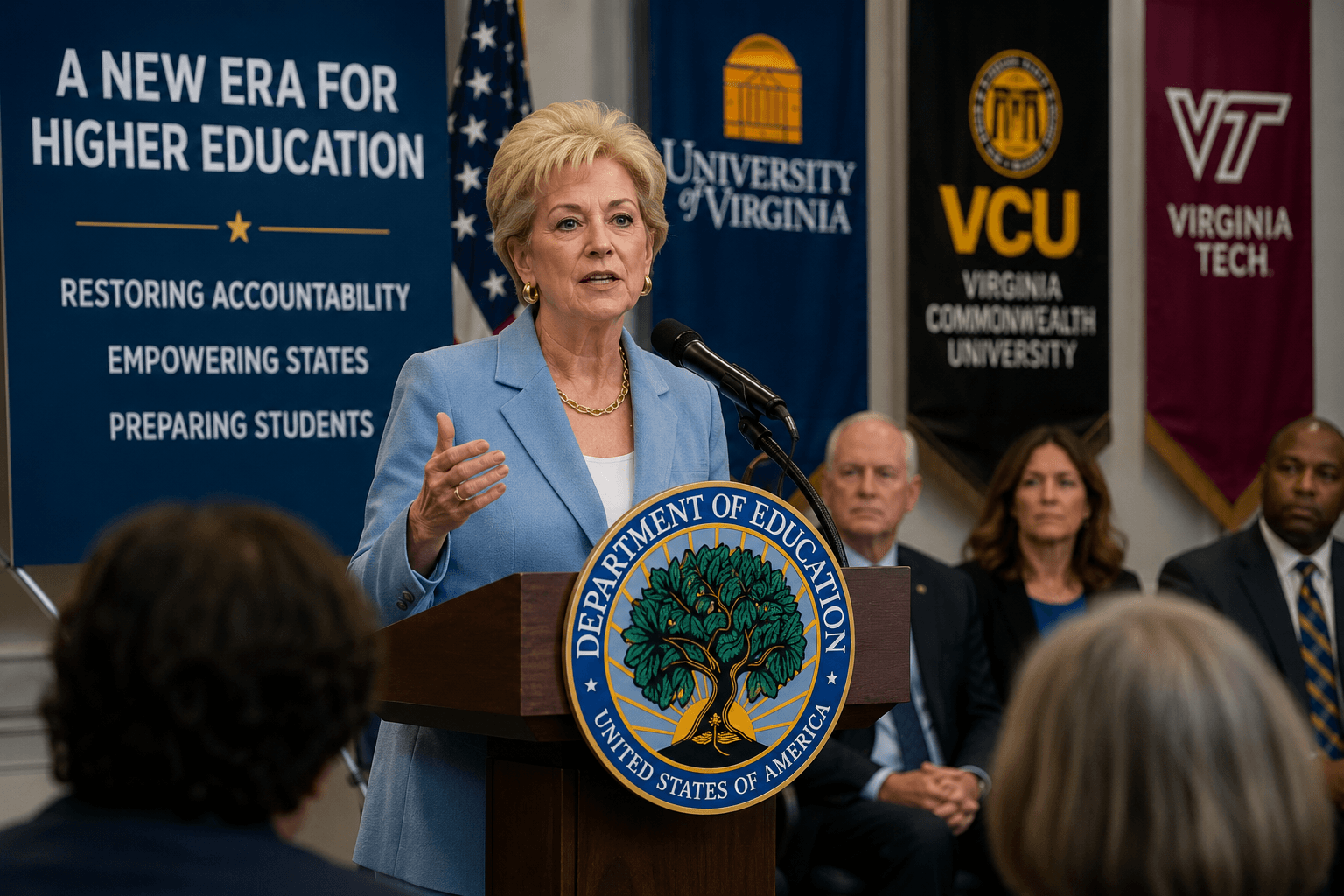

RICHMOND, Virginia.— U.S. Secretary of Education Linda McMahon is calling on Virginia’s colleges and universities to reconsider institutional practices and strengthen public confidence in higher education as the Trump administration moves forward with a broader effort to reduce Washington’s role in education.
McMahon delivered the message Tuesday as colleges across Virginia prepare for the beginning of another academic year, placing the state’s universities within a national debate over the cost, purpose and political direction of American higher education.
Receive breaking news alerts
Immigration, New York, Dominican Republic and investigative news delivered directly to your phone and computer.

Free — unsubscribe anytime.
Speaking to university leaders, the education secretary argued that institutions need to demonstrate that they are serving students and the public while remaining focused on academic excellence.
Her remarks come during a period of major changes at the U.S. Department of Education, where the Trump administration has pursued policies intended to transfer greater authority to states and local governments.
The administration has argued that decisions affecting schools and students should increasingly be made closer to the communities they serve rather than through federal regulations established in Washington.
That approach has already produced significant changes.
The Education Department has approved new flexibility for several states in the administration of federal education programs, allowing state officials greater discretion over how some federal funds are distributed and how certain education requirements are implemented.
At the same time, the administration has intensified its scrutiny of colleges and universities over admissions, civil rights compliance, campus policies and the use of race in education.
Higher education has become one of the most closely watched areas of that effort.
The administration maintains that universities receiving federal money must comply strictly with federal civil rights laws and cannot use diversity initiatives as a mechanism for providing advantages or disadvantages based on race.
The issue has gained greater importance since the Supreme Court’s 2023 decision restricting the use of race in college admissions.
Federal agencies have subsequently opened investigations into universities and professional schools over allegations that some institutions continued considering race indirectly after the ruling.
McMahon’s message to Virginia university leaders extends beyond admissions.
The secretary has argued that colleges need to rebuild public confidence at a time when families are increasingly questioning tuition costs, the economic value of some degrees and whether universities remain focused on their fundamental educational mission.
That debate is particularly significant as students and parents confront the rising financial consequences associated with higher education.
For many families, choosing a university now involves not only academic considerations but also calculations about student debt, employment prospects and the long-term financial return of earning a degree.
The Trump administration has increasingly emphasized those economic outcomes as part of its higher-education agenda.
McMahon’s appearance in Virginia also comes as the federal government continues pursuing one of President Donald Trump’s central education objectives: reducing the size and influence of the Department of Education itself.
The administration has promoted what it calls a “returning education to the states” strategy, arguing that state governments should have greater control over federal education dollars and educational policy.
Supporters of the approach contend that states and local communities understand the needs of their students better than federal officials and can respond more effectively when they are given greater flexibility.
Critics have warned that weakening federal oversight could produce significant differences in educational opportunities and civil rights enforcement from one state to another, particularly for students in communities that depend heavily on federal assistance.
Universities are therefore entering the 2026-27 academic year in an unusually complicated environment.
They face pressure to control costs and demonstrate the economic value of their programs while simultaneously adapting to changing federal civil rights policies and a government seeking to reduce Washington’s traditional role in education.
For Virginia’s colleges and universities, McMahon’s message was that institutional reform should not simply be viewed as a response to federal pressure.
The administration believes universities have an opportunity to reconsider how they operate and restore confidence among students, families and taxpayers.
Whether university leaders embrace that vision or challenge portions of the administration’s agenda could become one of the major education battles of the coming academic year.
What is already clear is that American higher education is entering another period of significant change — one in which questions about federal authority, academic independence, affordability and public trust are increasingly converging on the nation’s campuses.

Comments (0)
Be the first to join the conversation.