
For the third time since 2024, President Donald Trump emerged alive from a scene that, for a few seconds, seemed to tilt toward tragedy. It was not in an open field or in the middle of a political rally, but inside an elegant, brightly lit ballroom designed to celebrate the press and freedom of expression.
On the night of April 25, that atmosphere shattered abruptly, ironically during an annual event dedicated to the press and the First Amendment to the United States Constitution, which protects freedom of speech, in an edition closely watched as it marked Trump’s first attendance since assuming the presidency.
Receive breaking news alerts
Immigration, New York, Dominican Republic and investigative news delivered directly to your phone and computer.

Free — unsubscribe anytime.
It began as a formal evening at the Washington Hilton. Tables set, low conversations, glasses raised in a near-automatic ritual. No one anticipated that, just a few steps away, order was about to collapse.
An armed man carrying guns and knives burst into the lobby and moved with determination toward the heart of the event. Within seconds, the sharp crack of gunfire shattered the illusion of safety.
The reaction was instinctive and brutal. Bodies dropped to the floor, chairs scraped, muffled screams filled the room. Some attendees froze, others crawled under tables, while several women tried to escape on all fours, dragging themselves through the chaos, attempting to flee from a threat they could not see but could feel closing in. The scene, fractured by fear and confusion, became surreal.
Amid the disorder, Secret Service agents responded with mechanical precision. The president was shielded and rushed off the stage within seconds, along with Vice President JD Vance and First Lady Melania Trump.
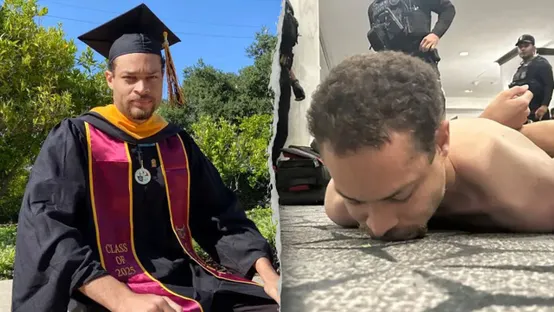
The attacker, identified as Cole Tomas Allen, 31, of Torrance, California, was not a marginal or unknown figure within academic circles. According to Reuters, he was a Caltech graduate, a part-time teacher, and a video game developer, holding a degree in mechanical engineering and a master’s in computer science. He had also worked as a teaching assistant and mechanical engineer before entering the education field. That profile, seemingly distant from the violence he unleashed in Washington, adds a disturbing layer to the case as authorities seek to understand what drove him to storm one of the most heavily secured political and media events in the country.
The attacker was subdued after breaching security barriers. One agent was struck in a bullet-resistant vest. The assailant was immobilized and taken into custody. But what unfolded that night was not an isolated event. It marked the third time in less than two years that Trump’s life had been directly threatened.
The first incident dates back to July 13, 2024, in Butler, Pennsylvania. A campaign rally turned into a war zone. Shots rang out from a distance, a bullet struck the then-candidate, blood visible on his face, panic spreading through the crowd. A firefighter was killed. The attacker was shot dead. That moment marked the beginning of a new phase of vulnerability.
Two months later, on September 15, 2024, danger resurfaced in what appeared to be a controlled environment. At his golf course in West Palm Beach, Florida, an armed man was detected before carrying out an attack. He was arrested and later convicted. The attempt never fully unfolded, but it confirmed that the threat remained.
The night of April 25, 2026 confirmed that the cycle has not ended, unfolding in a different, more intimate, and more disturbing setting. A closed space, with no clear escape routes, where fear spread with greater intensity. There were no warnings. Only noise, confusion, and the collective sense that something had broken.
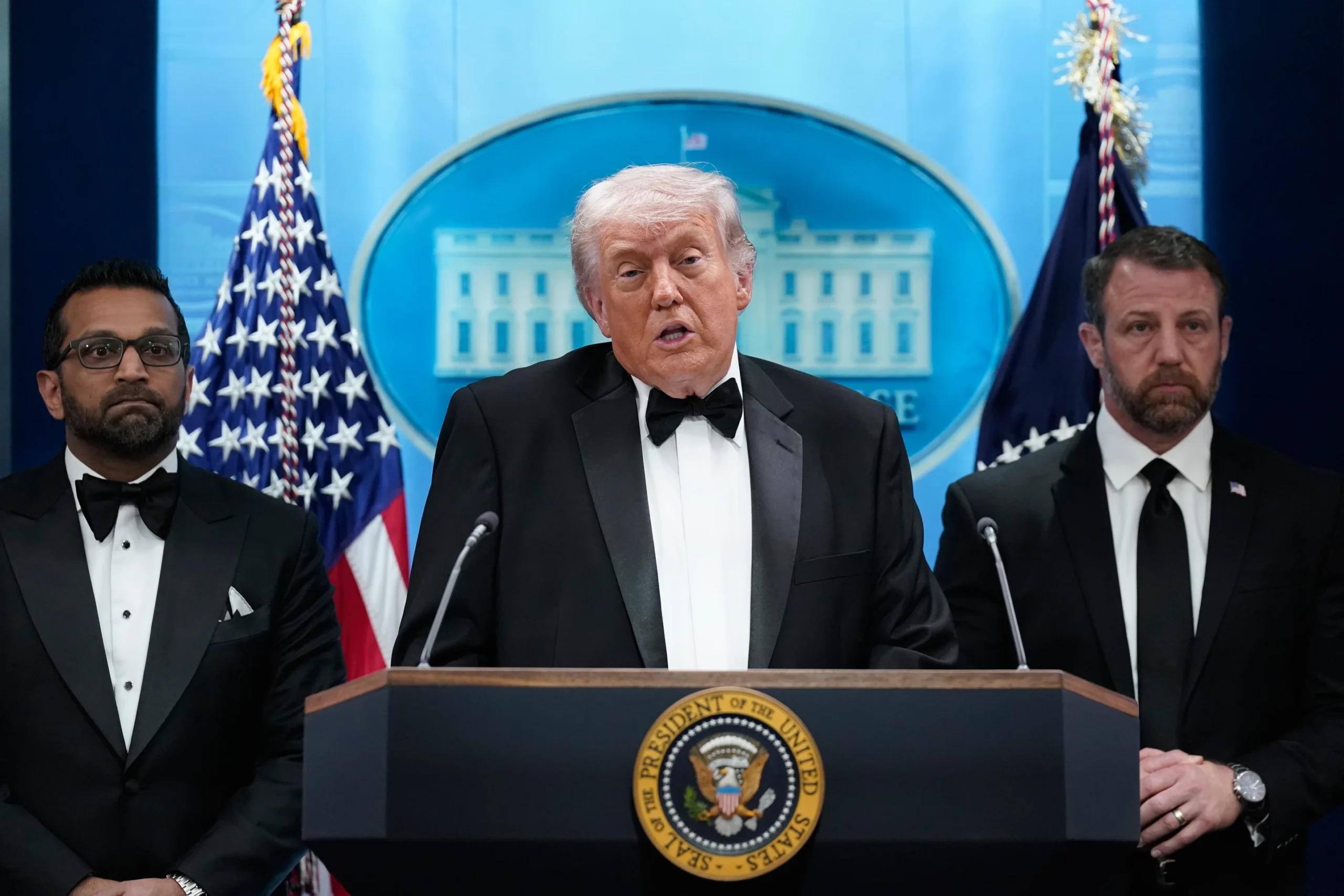
Hours later, under protection, Trump reappeared at the White House. Still dressed in formal attire, he briefly addressed the press. He said that when a figure has impact, they become a target. Authorities, he noted, consider the attacker a lone individual.
Inside the ballroom, the evacuation was chaotic and uneven. Vice President JD Vance was removed first. Then the president and the first lady, surrounded by a ring of security moving through overturned glasses, disordered tables, and faces still in shock. The event, which moments earlier followed a predictable script, had become a fractured scene.
There was an attempt to restore normalcy. Hotel staff reset tables, replaced napkins, adjusted lighting, and prepared the teleprompter. But the illusion did not hold. The dinner was canceled.
FBI Director Kash Patel confirmed that the investigation is ongoing, including analysis of weapons, shell casings, and witness statements. Outside, a different scene unfolded, helicopters overhead, National Guard units deployed, and a secured perimeter that contrasted sharply with the calm of earlier hours.
What remained was not only the interruption of an event, but a persistent question. How, in an environment designed to be among the most secure in the country, did an armed man get so close? And more importantly, what does it mean that, in less than two years, the president has come within reach of a tragic outcome three times?
That night, the dinner did not end. The sense of vulnerability did not either.

Comments (0)
Be the first to join the conversation.