
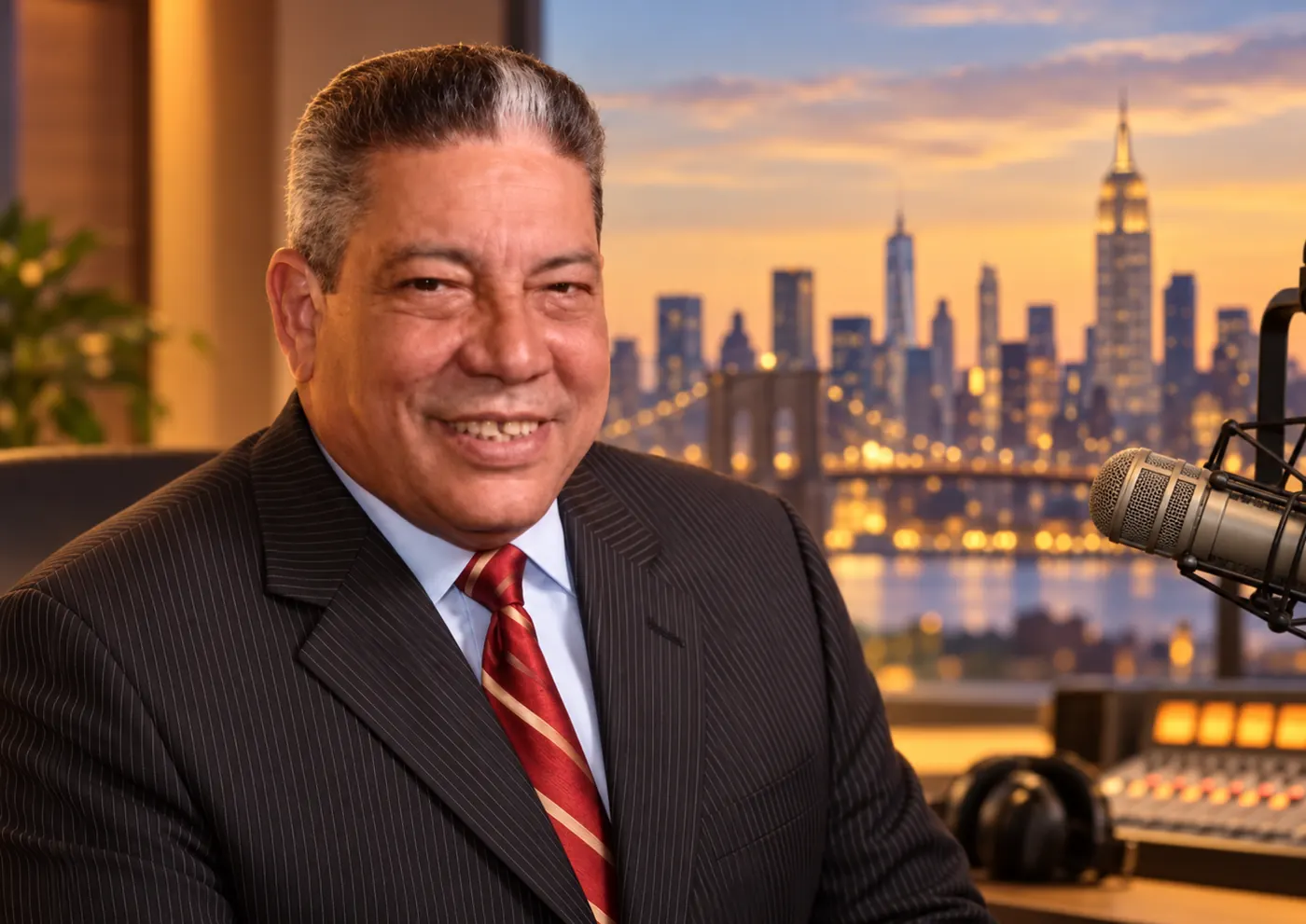
NEW YORK.- For decades, Dominicans in New York did not need to see a face to know who was on the other side of the microphone. One voice was enough. Francis Méndez achieved something few broadcasters do: he became part of the everyday memory of a community that learned to live far from home without ever stopping its connection to it.
That voice fell silent on Tuesday, September 8. Méndez died at age 75 in New York, according to his family. Reports published in the city said he died at NewYork-Presbyterian/Columbia University Irving Medical Center in Upper Manhattan, accompanied by his wife, Josefina, and several of his children. He had been facing health problems for some time and had required hospitalization on other occasions, although the family has not publicly disclosed a specific medical cause of death.
Receive breaking news alerts
Immigration, New York, Dominican Republic and investigative news delivered directly to your phone and computer.

Free — unsubscribe anytime.
He was born in Jarabacoa, Dominican Republic, on March 28, 1951. His entry into broadcasting was partly accidental. In interviews years later, he said that as a teenager he helped promote a liquor store and that his way of advertising the product drew attention because of his voice and pronunciation. That experience opened the doors of Radio Jarabacoa and, later, a profession that would occupy nearly his entire life.
On December 15, 1969, at age 18, he began a decisive chapter at Radio Guarachita, one of the Dominican Republic’s most influential popular stations. He remained there until 1980 and did more than play records or introduce songs. He also became involved in artistic promotion and was recognized as a discoverer or promoter of figures such as Leonardo Paniagua and Cheché Abreu. During those years, he also worked as Fernando Villalona’s representative during an important stage of the merengue singer’s career.
In 1990, he moved to New York. He settled in Washington Heights, where the Dominican community was growing and building a powerful social, commercial and cultural structure. There, Francis Méndez found an audience that needed voices able to speak in familiar codes, but also with the rhythm of the city it had adopted as home.
His time at La Mega 97.9 FM made him one of the recognized figures of New York Hispanic radio. He was part of “El Vacilón de la Mañana,” one of the highest-rated programs, and in 2000 he created a character within the show who delivered serious news using the popular language of New York’s streets. The formula brought him even closer to listeners.
Another program came to define a different side of his radio personality. “Señor Bolero,” broadcast on Amor 93.1 FM, placed him before an audience in love with romantic music. The program reached the top spot in the ratings according to Nielsen measurements and turned Méndez into one of the leading voices for bolero on New York Hispanic radio.
His voice also moved beyond the radio booth. He was the official voice of Univision Channel 41 from 1993 to 1999, had previously worked for Discovery Channel and later held similar duties at Telemundo Channel 47. He also appeared in “El Vacilón, The Movie” and worked extensively as a master of ceremonies in New York and New Jersey.
In recent years, he remained connected to communications and the Dominican community. He served as a director of Prensa & Comunidad Hispana, PreCoHis, and stayed involved in audiovisual projects and spaces devoted to preserving musical and artistic memory. His career crossed two countries, several generations and nearly every technological transformation radio experienced over the last five decades.
The family said that, at the communicator’s express wish, there will be no wake or funeral. His remains will be cremated in a strictly private ceremony. He is survived by his wife, four children and an extensive family.
Francis Méndez had earned the nickname “The Voice of Dominican Identity Abroad.” It was not merely a phrase associated with a broadcaster. For much of his professional life, his voice truly was there, accompanying Dominicans who had left their country and who, whenever they turned on a radio in New York, could feel a little closer to home.

Comments (0)
Be the first to join the conversation.