
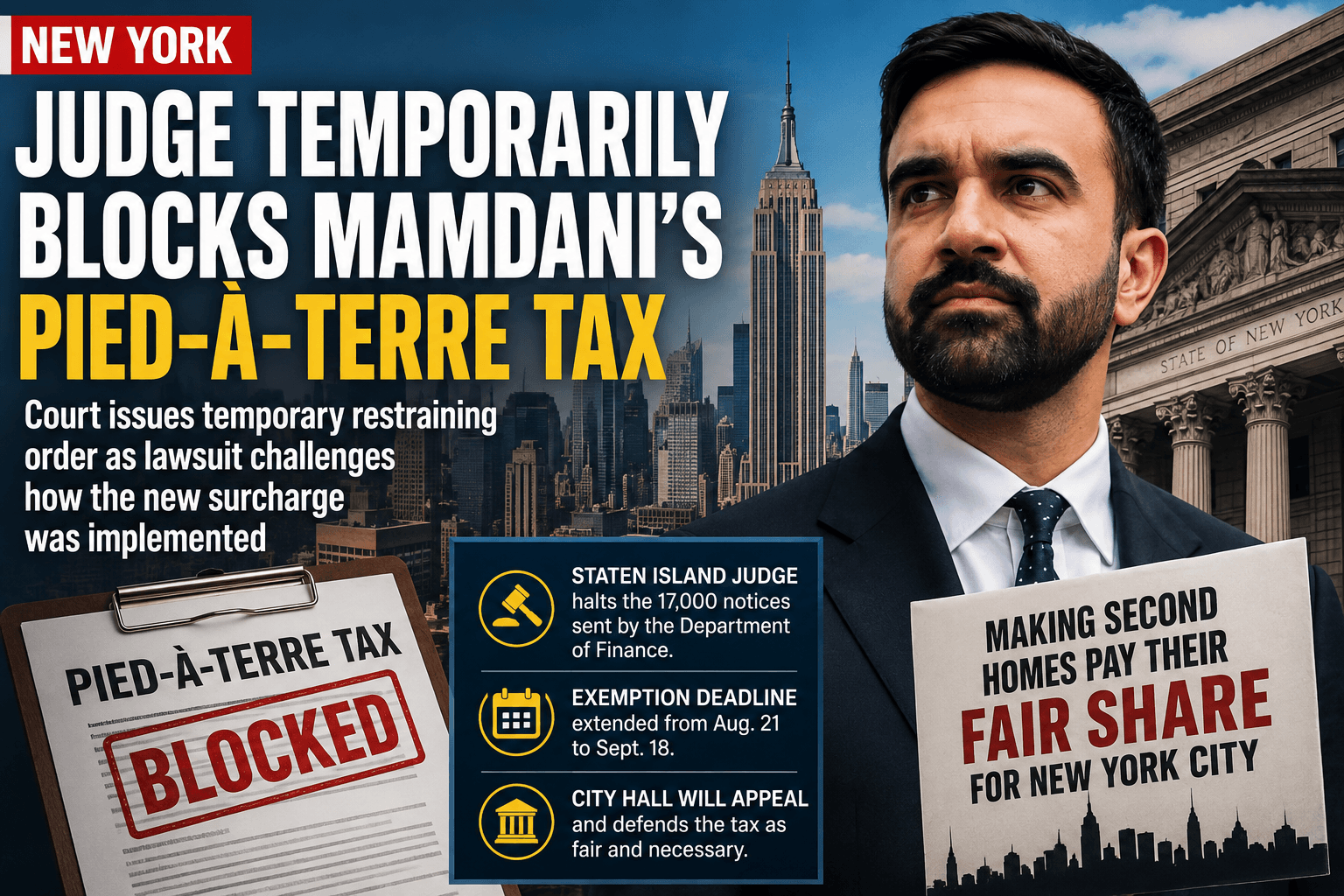

NEW YORK.- A New York State Supreme Court judge in Staten Island on Monday temporarily halted implementation of a new tax surcharge on luxury residential properties that are not used as primary residences, one of the tax measures advanced by Mayor Zohran Mamdani’s administration.
The decision was issued by Judge Wayne Ozzi, who granted a temporary restraining order while a lawsuit filed by three property owners challenges the way the city’s Department of Finance implemented the so-called pied-à-terre tax. The next hearing in the case is scheduled for August 31.
Receive breaking news alerts
Immigration, New York, Dominican Republic and investigative news delivered directly to your phone and computer.

Free — unsubscribe anytime.
The court order does not constitute a final ruling on the legality of the tax. The litigation focuses primarily on the procedures used by the city to identify properties potentially subject to the surcharge and notify their owners.
The new tax structure targets certain high-value residential properties that are not the owners’ primary residences. It includes homes valued at $5 million or more, as well as certain condominium and cooperative apartments that meet the thresholds established by law.
The controversy intensified after approximately 17,000 property owners received notices from the Department of Finance informing them that their properties could be subject to the new surcharge. Some residents complained that they received the notices even though the properties identified by the city were their primary residences.
The property owners who brought the case to court are challenging the city’s procedures and argue that officials improperly shifted the burden onto residents to prove that their homes were exempt from the new tax.
Monday’s order temporarily prevents the Department of Finance from taking further action related to the approximately 17,000 notices sent to property owners while the court considers the case.
Before the court intervened, the city had already extended the deadline for notified property owners to apply for an exemption from August 21 to September 18. The extension was intended to give residents additional time to demonstrate that the property in question is their primary residence or to seek assistance from the Department of Finance in completing the process.
The Mamdani administration immediately pushed back against the ruling. A City Hall spokesperson said the administration disagrees with the decision and remains confident both in the surcharge and in the city’s ability to implement it fairly and effectively.
City Hall maintains that the measure is intended to require owners of high-value second homes to contribute a greater share to the city’s finances. The administration announced that the city’s Law Department will immediately appeal the ruling.
The tax has generated intense political and economic debate in New York. Supporters argue that it would require wealthy owners of luxury properties to contribute more toward the city’s finances while benefiting from municipal services without using those properties as their primary residences.
Critics, meanwhile, have challenged both the tax itself and the way it was implemented, warning of potential consequences for the real estate market. The lawsuit now adds another issue to the debate: whether city officials conducted sufficient verification before identifying thousands of properties as potentially subject to the surcharge.
The legal battle is only beginning. The order is temporary and does not permanently invalidate the tax. The court will continue reviewing the property owners’ claims while the Mamdani administration seeks to overturn the decision and proceed with implementation of the measure.

Comments (0)
Be the first to join the conversation.