
BRUSSELS, Belgium.— Moving to another country is never only about crossing a border. Then come the language, documents, work, children’s school and the first question so many immigrants ask far from home: where can I find my own people?
In Belgium, part of that answer began to take shape around the Dominican Social and Cultural Association in Belgium, a nonprofit organization created to bring together Dominicans living in the country, their partners and Belgian citizens connected to the Dominican Republic.
Receive breaking news alerts
Immigration, New York, Dominican Republic and investigative news delivered directly to your phone and computer.

Free — unsubscribe anytime.
For years, the association served as a meeting point for a community that was still small and scattered.
José Gómez Cerda, who moved to Belgium with his family in 1992, led the organization from 1995 to 2004. His testimony helps reconstruct a period when Dominicans began developing community structures in a country where they still had little public representation.
The association eventually brought together about 240 members. The vast majority were women—approximately 220, compared with about 20 men—according to figures provided by Gómez Cerda.
Behind those numbers were stories of migration, binational marriages, families starting over and Dominicans learning how to navigate a different society.
The organization did not limit itself to social activities. It also promoted educational and cultural gatherings, guided community members and maintained relations with the Dominican Embassy in Brussels.
During that period, diplomatic representatives took part in association activities, and meetings, conferences and gatherings were coordinated to keep Dominicans connected to their country’s institutions.
Names such as Rafael Torres, Arbelis Encarnación, Mario Ángeles, Ana Celenia Alemán and Peggy van Lierde appear among its members. Van Lierde, a Belgian citizen, also became actively involved in the organization’s initiatives.
That community experience took place long before Dominican embassies began developing permanent programs specifically aimed at giving visibility to the diaspora.
Today, that connection takes other forms.
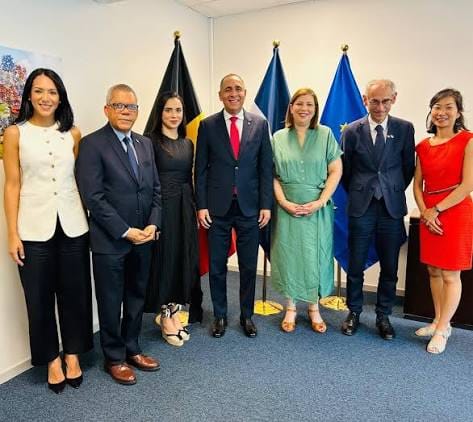
In November 2024, the Dominican Embassy in Belgium and Luxembourg recognized thirteen community members for their stories of work, integration and contribution to the societies where they live. The “Coffee at the Embassy” program was created precisely to tell those stories and bring the diplomatic representation closer to Dominicans in that part of Europe.
A year earlier, more than 200 Dominicans living in Belgium and Luxembourg took part in a meeting in Brussels with President Luis Abinader, organized with the support of community leaders.
These are different scenes from the same story. The community that decades ago needed to organize itself in order to recognize one another now has associations, leaders, professionals and families who are part of Belgian life.
But before that visibility came small rooms, meetings, dances, conversations and people willing to welcome newcomers. That is how part of the Dominican presence in Belgium began to take shape: not through a large institution, but through a community that understood early on that living far from the Dominican Republic did not mean having to do so alone.

Comments (0)
Be the first to join the conversation.