
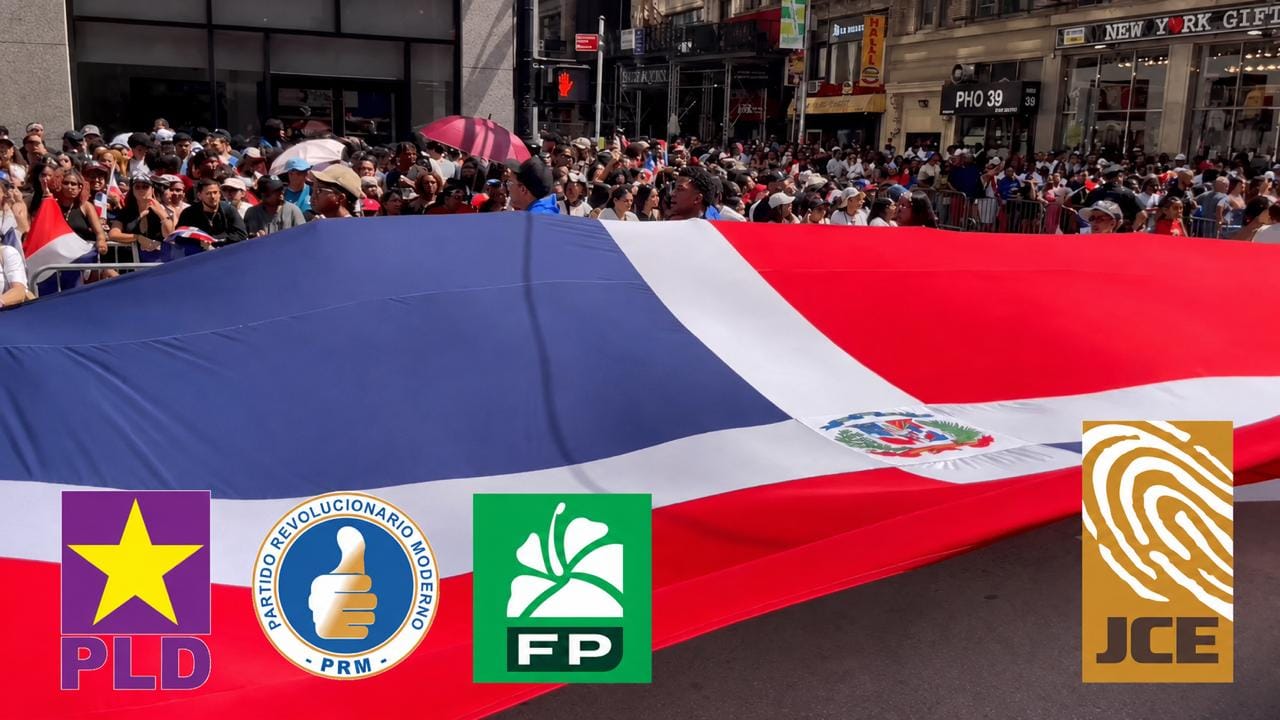

NEW YORK.— Dominican political parties have spent years looking at nearly empty polling stations abroad without fully understanding the message. They have called it apathy. They have blamed long distances, insufficient voting centers and logistical difficulties. Yet behind that silence, a greater threat to the Dominican political system has been growing.
Hundreds of thousands of Dominicans stopped voting but retained their right to participate and continued registering. That electoral force could reshape the 2028 elections if an independent figure emerges outside the traditional party structures and becomes a vehicle for social reckoning against patronage, broken promises and the disputed management of public funds.
Receive breaking news alerts
Immigration, New York, Dominican Republic and investigative news delivered directly to your phone and computer.

Free — unsubscribe anytime.
In 2024, the 863,785 Dominicans registered to vote abroad represented 10.6 percent of the national electorate. The diaspora surpassed Santiago Province, which had 785,287 eligible voters, by 78,498 people. It therefore displaced Santiago as the Dominican Republic’s second-largest electoral district, behind only Santo Domingo Province.
Viewed as a single constituency, that community spread across the United States, Europe, Latin America and the Caribbean became a second Dominican electoral capital.
External voting emerged from a democratic campaign led by José Francisco Peña Gómez during the political process that produced the 1994 Pact for Democracy. Three decades later, academic Julio Bernardo Nicolás Vega de Boyrie proposed eliminating it, reopening a debate involving partisan interests, overseas congressional seats, public spending and questions about its usefulness.
But the diaspora had already delivered its verdict.
Turnout reached 66.82 percent in 2004, fell to 49.56 percent in 2008 and declined again to 44.87 percent in 2012. After recovering to 48.70 percent in 2016, participation collapsed to 21.79 percent in 2020 and dropped further to 19.04 percent in 2024.
The retreat coincided with declining confidence in political parties. Latinobarómetro 2024 found that only 28 percent of Dominicans trusted them. Abroad, a widespread perception developed that political organizations appeared during campaigns, distributed promises and government positions, and vanished once the votes were counted.
Questions also intensified over funds administered by the Central Electoral Board, known as the JCE.
An El Faro Latino investigation examined 18,800 documents provided by the JCE concerning the 2020 elections. A forensic audit conducted by Disla Doñé & Asociados identified a deficit of $4,618,696.76, then equivalent to 258,647,019 Dominican pesos.
The findings were submitted to the Office of the Specialized Prosecutor for the Prosecution of Administrative Corruption, but the case did not advance and no responsibility was established. The chronology was documented in “La Cara Rota de la Diáspora,” a book by Esteban Cabrera, who led the journalistic investigation.
A second investigation, also directed by Cabrera, followed the money allocated for the 2024 overseas elections. After receiving incomplete records, El Faro Latino petitioned the Superior Administrative Court and obtained ruling 0030-1642-2025-SSEN-00203, ordering the JCE to release all the requested information.
The agency subsequently delivered 1,642 files, but an audit determined that essential records were still missing. The newspaper continues pursuing enforcement of the ruling.
By August 22, 2026—two years, three months and three days after the elections—the country still did not know the complete cost of overseas voting, while the JCE continued financing its legal defense with public funds.
Experiences in Peru and Colombia have demonstrated that diaspora voters can determine a presidential election when the contest is close. If a credible figure transforms Dominican silence abroad into a protest vote, the cry of “throw them all out” could cease to be an expression of frustration and become an electoral verdict.

Comments (0)
Be the first to join the conversation.