
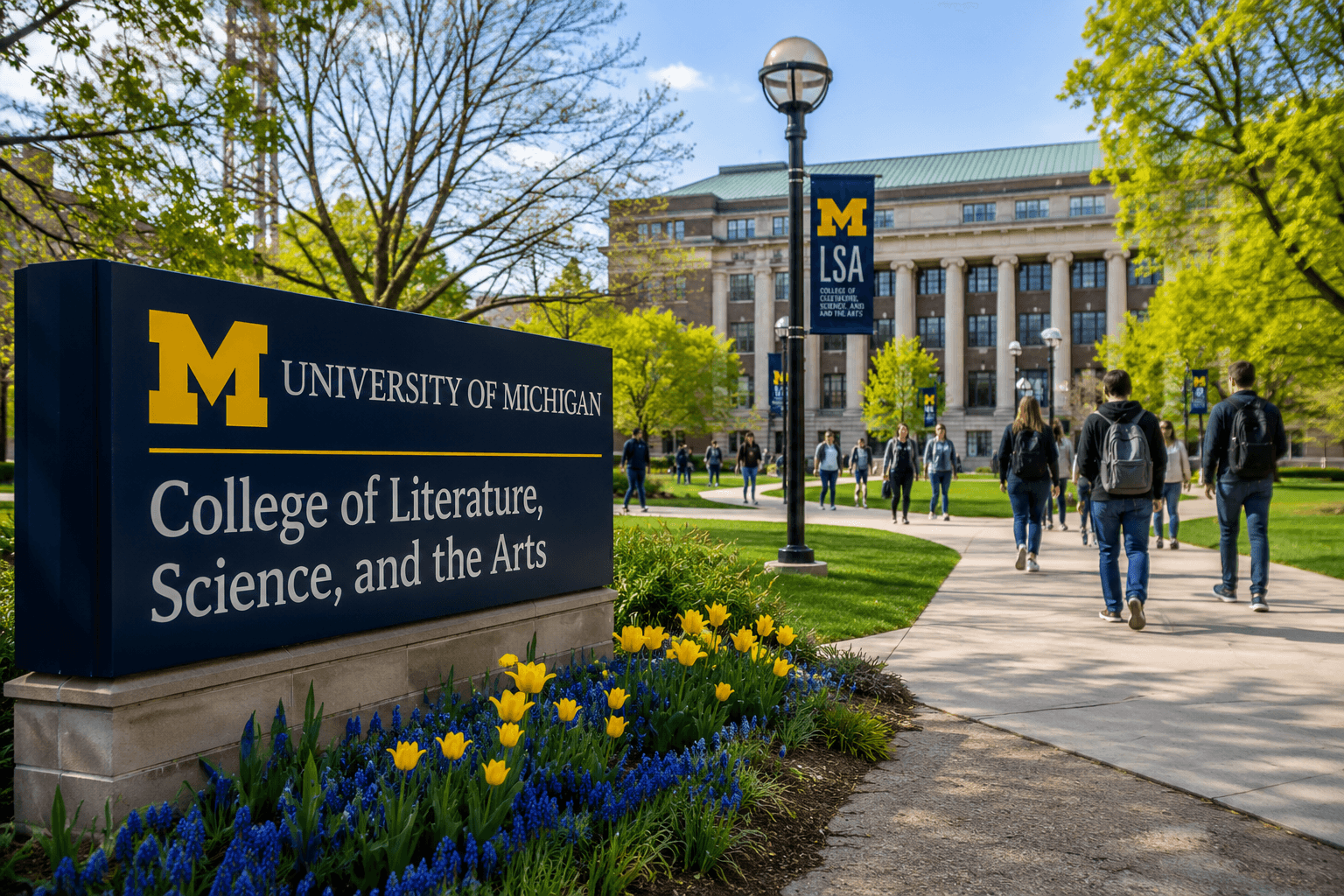

ANN ARBOR, Michigan.— First-year students entering one of the University of Michigan’s largest colleges in fall 2027 will experience a significantly different approach to grading during their first semester: their letter grades will not appear on their official transcripts.
The new policy will apply to incoming freshmen enrolled in the College of Literature, Science, and the Arts, known as LSA. Instead of displaying traditional letter grades for that first semester, transcripts will record courses as either “P” for pass or “NC” for no credit.
Receive breaking news alerts
Immigration, New York, Dominican Republic and investigative news delivered directly to your phone and computer.

Free — unsubscribe anytime.
University officials say the initiative is designed to ease the transition from high school to college, encourage students to explore unfamiliar academic subjects and address concerns about mental health and well-being among college-age students.
Students will still receive regular letter grades throughout their courses and will know how they are performing academically. The major difference comes at the end of the semester: those grades will not be displayed on the official transcript or calculated into the student’s grade point average.
LSA is the largest of the University of Michigan’s 19 schools and colleges and serves approximately 19,700 undergraduate students.
University officials argue that removing the immediate consequences of first-semester letter grades could encourage new students to take intellectual risks that they might otherwise avoid.
A student interested in a difficult subject, for example, could enroll in a course outside his or her strongest academic area without worrying that one disappointing grade during the transition to college could permanently affect the GPA.
The university says the broader objective is to create an academic environment that places greater emphasis on learning, personal growth, connection and collaboration rather than competition during students’ first months on campus.
The letter grades, however, will not disappear completely.
The university will retain them internally and may use them for academic advising, scholarships and awards, athletic eligibility, internship or professional applications, financial aid determinations, degree progress and institutional reporting requirements.
The policy will apply only to students beginning their first year in LSA in fall 2027. Students will not be permitted to opt out and request that their traditional grades appear on their transcripts.
According to the university, making participation optional would undermine the purpose of the program because students worried about competing with classmates could feel pressured to retain traditional grades, recreating the same academic pressures the initiative is intended to reduce.
Michigan is not the first prominent U.S. institution to experiment with alternative grading systems for students adjusting to college. Institutions including the Massachusetts Institute of Technology, Swarthmore College and the California Institute of Technology have implemented variations of pass/no-record or modified grading approaches for first-year students.
The Michigan initiative nevertheless enters a broader national debate over how universities should respond to rising concerns about student stress and mental health.
Supporters of alternative grading systems argue that the first months of college can be particularly difficult. Students are simultaneously adapting to greater academic expectations, new social environments and, in many cases, living away from their families for the first time.
Critics question whether reducing the consequences associated with poor academic performance prepares students for those challenges or simply postpones them.
Psychotherapist and author Jonathan Alpert is among those criticizing the approach. He argues that experiencing disappointment, stress and even failure is a normal part of education and personal development.
Alpert told Fox News Digital that receiving a bad grade can certainly be stressful or embarrassing but should not automatically be treated as a mental health emergency. He contends that universities should help young adults develop resilience rather than attempt to remove ordinary sources of discomfort from academic life.
His criticism reflects a larger disagreement surrounding what he describes as the expansion of “therapy culture” into education — the idea that normal emotional responses such as anxiety, disappointment or academic stress are increasingly being interpreted through the language of mental health.
University officials see the issue differently.
Michigan says the policy is intended not to eliminate academic standards but to provide students with a transitional period in which learning itself becomes the primary motivation. Because students will continue receiving letter grades and the university will retain those results internally, academic performance will still be measured.
The difference is that a difficult first semester will not immediately become a permanent part of the student’s public academic record or GPA.
When the policy takes effect in fall 2027, Michigan will become another major institution testing whether changing the traditional grading system can improve the transition to college without weakening academic expectations.
That experiment will also place the university at the center of a larger question confronting American higher education: how far colleges should go to protect student well-being while still preparing young adults to confront failure, competition and pressure beyond the classroom.

Comments (0)
Be the first to join the conversation.