
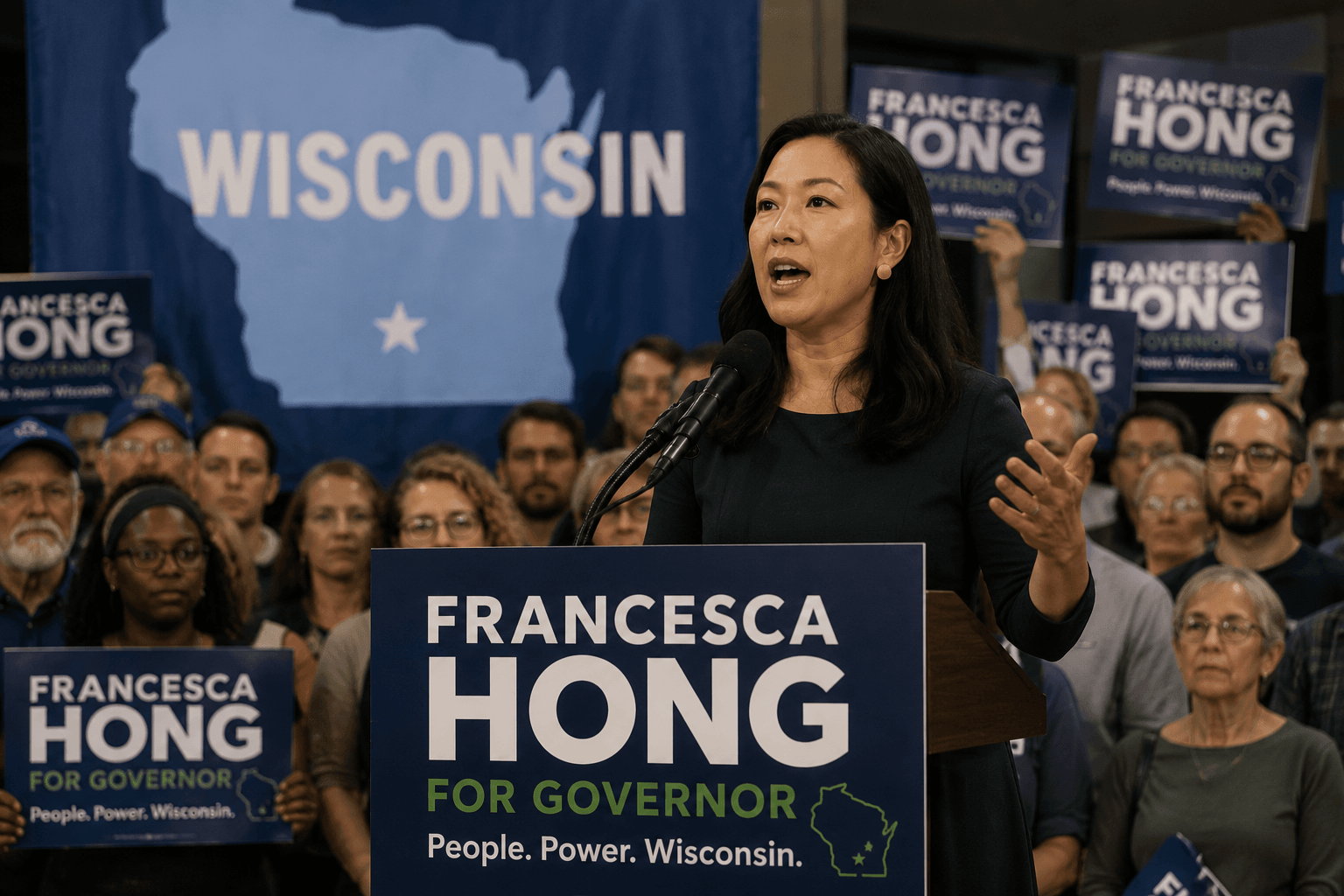
MADISON, Wisconsin.— Wisconsin’s Democratic gubernatorial primary is emerging as an important test for the progressive movement, with democratic socialist Francesca Hong positioned to potentially defeat Milwaukee County Executive David Crowley, the candidate backed by Gov. Tony Evers.
But as Tuesday’s primary approaches, some of the most recognizable figures on the American left are staying out of the contest.
Receive breaking news alerts
Immigration, New York, Dominican Republic and investigative news delivered directly to your phone and computer.

Free — unsubscribe anytime.
Hong’s campaign has attracted support from progressive organizations and several prominent lawmakers, but neither Sen. Bernie Sanders of Vermont nor Rep. Alexandria Ocasio-Cortez of New York has endorsed her.
A Hong victory would represent a significant defeat for Wisconsin’s Democratic establishment and could provide progressives with an opportunity to test whether their political agenda can succeed statewide in one of the most competitive battlegrounds in the country.
The stakes extend beyond Wisconsin.
Some progressive organizers view the race as another indication of where the Democratic Party could be heading ahead of the 2028 presidential election, particularly as younger politicians and democratic socialists seek greater influence within the party.
Yet Hong has not received the level of national progressive support that other candidates have attracted.
Sanders, whose democratic socialist movement has influenced a generation of progressive candidates, has said he will not endorse Hong. People familiar with his thinking told POLITICO that although Hong has referenced Sanders and his political philosophy during her campaign, the senator does not have a substantial personal relationship with her.
Sanders has acknowledged meeting Hong previously but has indicated that their relationship does not extend much further.
Questions about Hong’s campaign have also emerged among some progressive circles, particularly concerning her political messaging and her ability to compete in a statewide general election.
Part of that concern stems from controversial social media posts from earlier in her political career.
Hong previously advocated for defunding the police and made comments about canceling Thanksgiving. She has since distanced herself from those positions, describing them as “bad takes” and saying she has learned from them.
Those statements could become significant in a general election in Wisconsin, where statewide races have repeatedly been decided by exceptionally narrow margins.
President Donald Trump carried Wisconsin in 2024 by fewer than 30,000 votes. Four years earlier, Joe Biden won the state by fewer than 21,000.
Republicans would likely attempt to make Hong’s democratic socialist identity and previous statements central issues if she advances to November.
The expected Republican opponent is Rep. Tom Tiffany, who has received Trump’s backing.
Some Wisconsin Democrats privately worry that Hong could face difficulty appealing to moderate Democrats and independent voters. A July Marquette Law School poll also found democratic socialism carrying a net negative rating among registered voters statewide.
Ocasio-Cortez has similarly declined to enter the Wisconsin primary.
The New York congresswoman has said her immediate political priority is helping Democrats regain control of Congress, particularly the House while improving the party’s chances of capturing the Senate.
Sanders and Ocasio-Cortez generally concentrate their endorsements on federal races rather than routinely intervening in state-level contests. Their absence from Hong’s campaign, therefore, does not necessarily constitute opposition to her candidacy.
Other prominent progressives have been more willing to get involved.
Rep. Ilhan Omar of Minnesota has traveled to Wisconsin to campaign alongside Hong, while California Rep. Ro Khanna has endorsed her. Progressive commentator Hasan Piker also appeared with Hong at a Milwaukee rally earlier this month.
Several national progressive organizations see the Wisconsin contest as an opportunity to demonstrate that candidates running on an unapologetically left-wing platform can win outside heavily Democratic congressional districts and major cities.
Alan Minsky, executive director of Progressive Democrats of America, has compared the opportunity facing Hong to the political rise of New York Mayor Zohran Mamdani.
Minsky argues that if Hong becomes governor and successfully implements policies that improve residents’ lives, voters could embrace her agenda regardless of ideological labels attached to it.
Whether that argument can survive Wisconsin’s general election environment remains an unanswered question.
Even Sen. Elizabeth Warren of Massachusetts, another nationally recognized progressive figure, indicated that she has little familiarity with Hong. Asked about the Wisconsin candidate, Warren responded simply that she did not know her.
That lack of national recognition illustrates the unusual position Hong occupies.
She is potentially days away from capturing the Democratic nomination for governor in one of America’s most politically important states, while remaining relatively unknown to several leaders of the movement with which she identifies.
A victory Tuesday would change that immediately.
It would give progressives another high-profile statewide nominee and force Democrats to confront a question that has followed the party through successive elections: whether candidates identified with democratic socialism and the activist left can build coalitions broad enough to win closely divided states.
For Hong, winning the primary would only settle the first part of that debate.
Wisconsin’s November election would provide the much more consequential test.

Comments (0)
Be the first to join the conversation.