
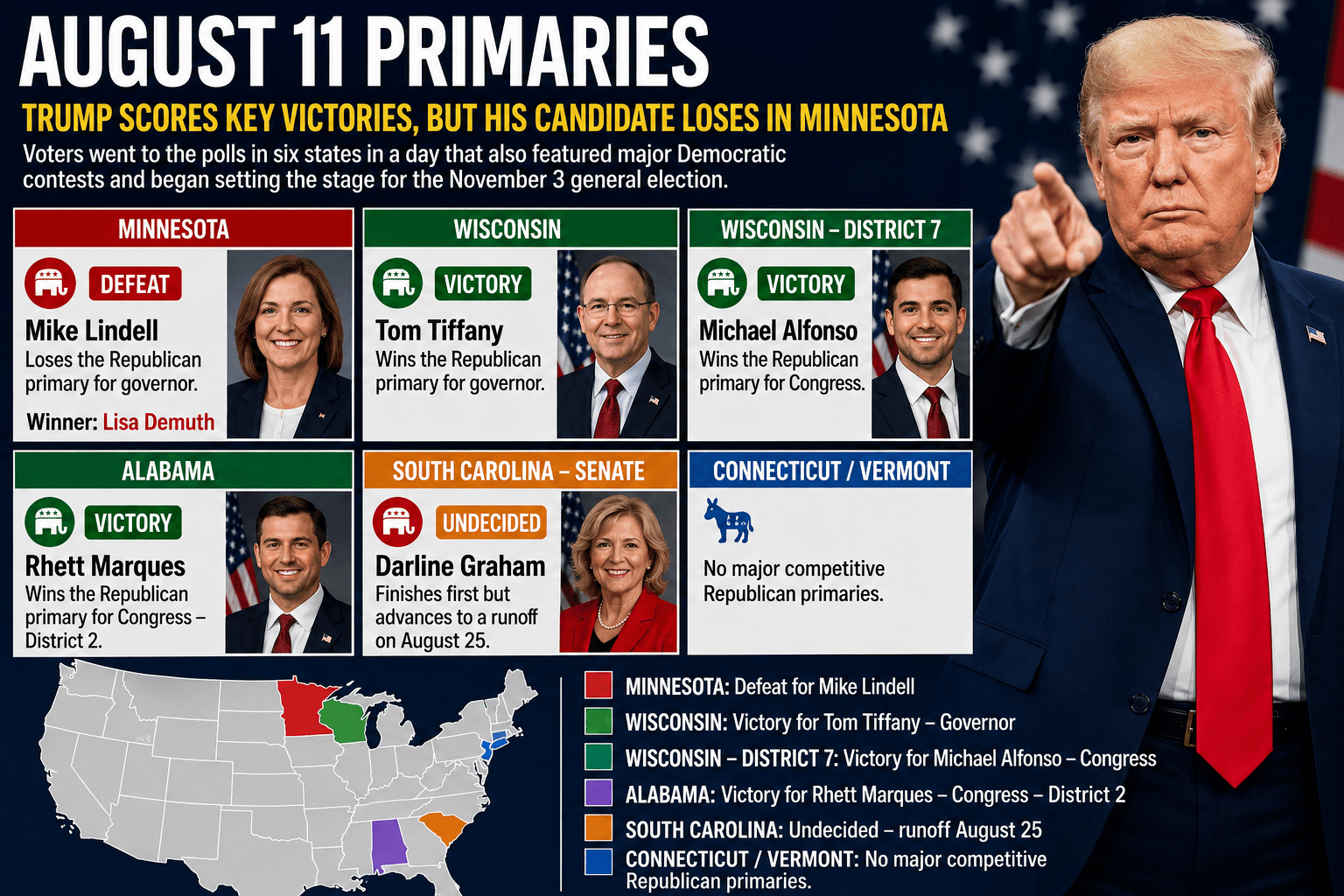

WASHINGTON.— The primaries held Tuesday, August 11, across six states provided a new measure of President Donald Trump’s political influence within the Republican Party, delivering significant victories for several candidates he endorsed but also a notable defeat in Minnesota that demonstrated his support does not automatically guarantee a nomination.
Voters went to the polls in Connecticut, Minnesota, Wisconsin, Vermont, Alabama and South Carolina in an election day that also exposed major internal divisions within the Democratic Party and began defining some of the key races ahead of the November 3 general election.
Receive breaking news alerts
Immigration, New York, Dominican Republic and investigative news delivered directly to your phone and computer.

Free — unsubscribe anytime.
Trump’s most visible setback came in Minnesota, where he had personally endorsed MyPillow founder Mike Lindell for the Republican gubernatorial nomination.
Lindell, one of the president’s most recognizable allies and a longtime promoter of claims of fraud related to the 2020 election, was defeated by Minnesota House Speaker Lisa Demuth.
The Associated Press and Reuters projected Demuth as the winner of the Republican nomination. She will now face Democratic Sen. Amy Klobuchar in November after Klobuchar secured her party’s gubernatorial nomination without significant difficulty.
Lindell’s defeat represents an exception in an election cycle in which most Republican candidates endorsed by Trump have managed to win their primaries. It also demonstrates that segments of the Republican electorate may prioritize political experience and perceived electability in November even when the president personally supports another candidate.
Wisconsin presented the opposite scenario.
U.S. Rep. Tom Tiffany, endorsed by Trump, secured the Republican nomination for governor and advanced to what is expected to be one of the most closely watched statewide elections in the country. Tiffany defeated businessman Andy Manske and was declared the winner shortly after polls closed.
Trump scored another victory in Wisconsin’s Seventh Congressional District.
Michael Alfonso, 26, the son-in-law of Transportation Secretary Sean Duffy, won a five-candidate Republican primary after receiving the president’s endorsement. Trump actively participated in his campaign, including a telephone event, and presented him to Republican voters as a candidate aligned with the MAGA movement.
The result was particularly significant because Alfonso faced questions within his own party about his age and limited political experience. The presidential endorsement helped propel him to the Republican nomination in a district previously represented by Duffy.
Alabama produced another victory for a Trump-backed candidate.
State Rep. Rhett Marques won the Republican nomination in the Second Congressional District in a six-candidate primary. Marques, who also received the endorsement of Sen. Katie Britt, will face Democratic Rep. Shomari Figures in November.
That election will have national significance because the district was redrawn following a Supreme Court decision, and Republicans believe they now have a considerable opportunity to reclaim a seat won by Democrats in 2024.
South Carolina delivered a more ambiguous result for Trump.
The president endorsed Sen. Darline Graham, sister of the late Sen. Lindsey Graham, who was temporarily appointed to fill the seat and is now seeking the Republican nomination to remain in the Senate.
Graham finished first in a 10-candidate primary with approximately 33% of the vote but failed to secure the majority needed to win outright. She will face Rep. Ralph Norman, who received about 24%, in a Republican runoff scheduled for August 25.
The result can be interpreted in two ways. Trump’s endorsement helped Graham finish first in a crowded field, but nearly two-thirds of Republican voters initially chose other candidates. The runoff will provide another test of the president’s ability to consolidate those voters behind his preferred candidate.
Connecticut and Vermont, by contrast, did not produce a comparable test of presidential endorsement power in the night’s major Republican contests.
The election also produced important signals within the Democratic Party.
In Minnesota, Lt. Gov. Peggy Flanagan defeated U.S. Rep. Angie Craig in the Democratic Senate primary, delivering another victory for the party’s progressive wing. Flanagan had received endorsements from prominent figures including Bernie Sanders and Elizabeth Warren.
Connecticut produced a different dynamic. Gov. Ned Lamont, representing the party’s institutional establishment, easily defeated progressive challenger Josh Elliott. But in the First Congressional District, former Hartford Mayor Luke Bronin defeated Rep. John Larson, who was seeking a 15th term in Washington, providing another sign of generational pressure against longtime lawmakers.
Wisconsin, meanwhile, remained home to one of the nation’s closest Democratic contests into the early morning hours. Milwaukee County Executive David Crowley, backed by Gov. Tony Evers, was virtually tied with State Rep. and democratic socialist Francesca Hong while tens of thousands of absentee ballots in Milwaukee remained to be processed.
The Republican results from the night show that Trump retains considerable influence over his party’s candidate selection.
Tiffany, Alfonso and Marques advanced with his endorsement. Darline Graham finished first and moves on to a runoff.
But Minnesota provided a warning.
Republican voters rejected one of the president’s best-known personal allies and chose Demuth despite Trump’s explicit endorsement of Lindell.
The August 11 primaries did not demonstrate a Republican Party breaking with Trump. They revealed something more nuanced: his endorsement remains one of the most powerful assets in a Republican primary, but voters remain willing to disregard it when they believe another candidate offers a stronger alternative for November.

Comments (0)
Be the first to join the conversation.